
This article has been reviewed according to Science X's editorial process and policies. Editors have highlighted the following attributes while ensuring the content's credibility:
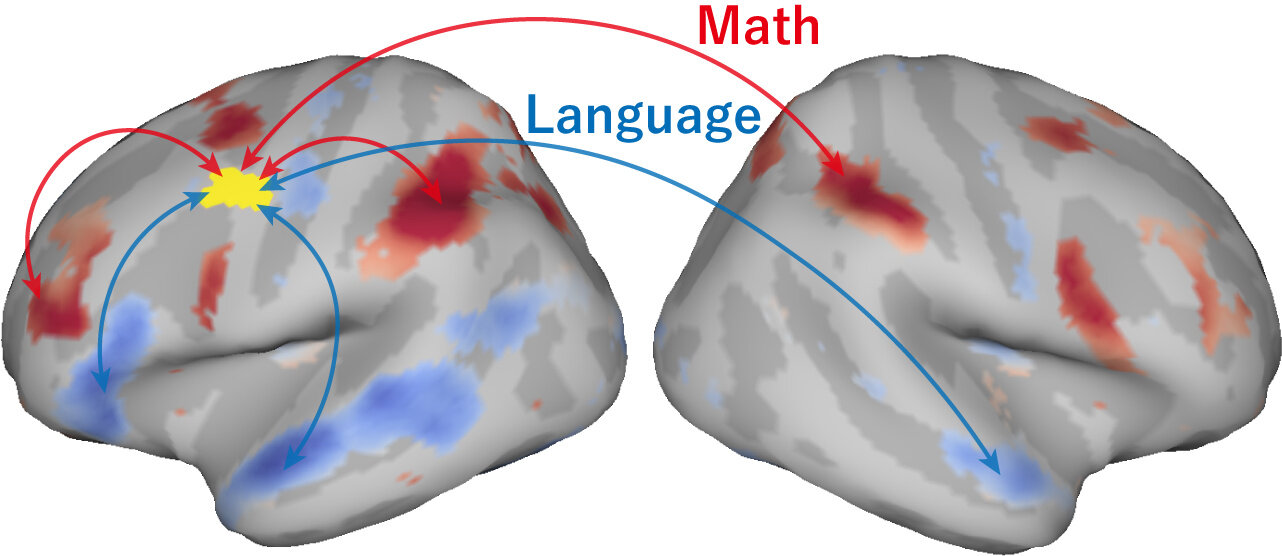
Researchers, including those at the University of Tokyo, are helping solve an ongoing debate in the field of neuroscience. Two contradictory positions assume that either math and language are processed in unique areas of the brain, or they are processed together somewhere. Their new research, published in the journal Science Advances, says both are correct in some way: While specialized regions do exist, so does a region newly identified as processing both math and language.
Unless you're a mathematician, you've probably looked down at a page of math equations before and thought it's like looking at a foreign language. But this is not simply a metaphor, and there is undeniably some overlap between math and language: Both deal with the manipulation, rearrangement and interpretation of symbols, and more things besides.
This has led some neuroscientists to believe that math and language are likely processed by the same region or set of regions in the brain. Conversely, math is often considered more abstract and independent of language. This and other reasons have led to another school of thought: They must be processed by entirely different regions with very little overlap.
Associate professor Tomoya Nakai from the Graduate School of Information Science and Technology at the University of Tokyo and his team are interested in the relation between language and math, and have even published papers showing overlapping activity related to these domains.
Source link





