
This article has been reviewed according to Science X's editorial process and policies. Editors have highlighted the following attributes while ensuring the content's credibility:
The human brain, like that of other mammals, is organized into different areas with distinct functions. While specific experiences or stimuli can activate several brain regions at once, different areas often use or process this information for different purposes.
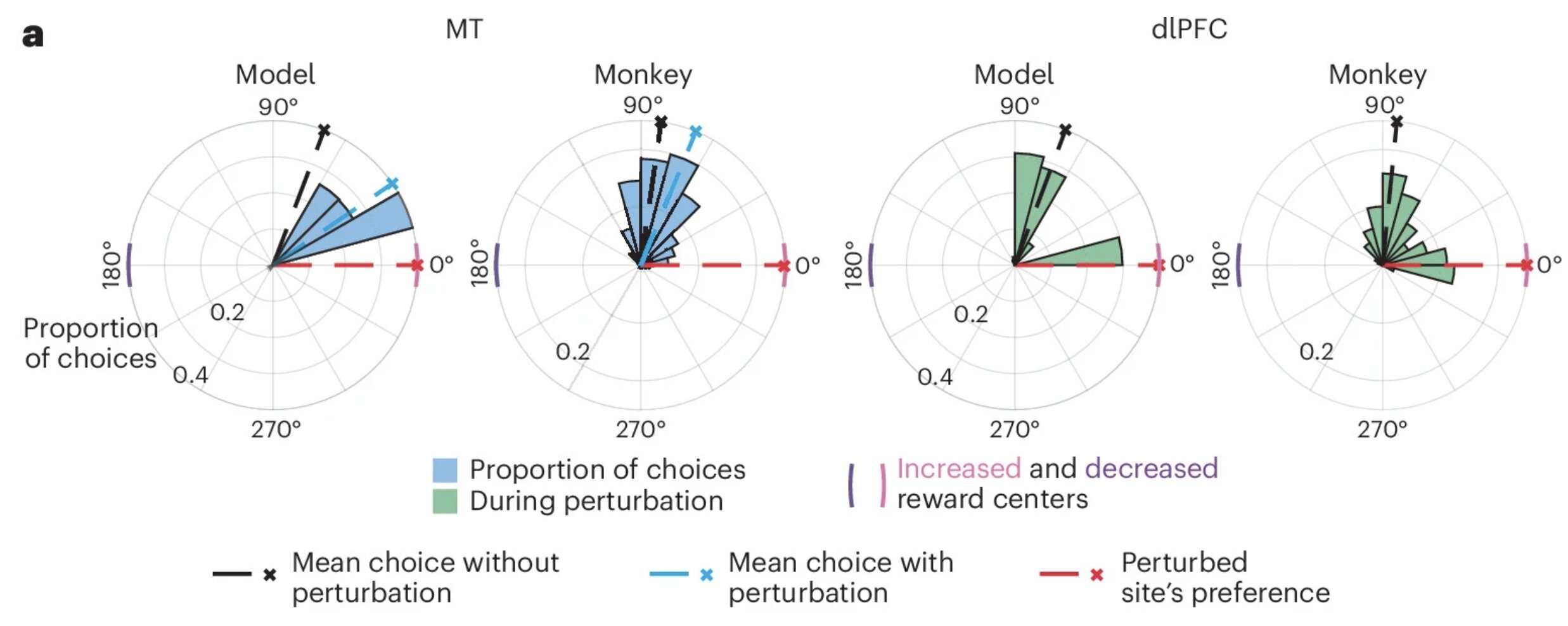
Researchers at the University of Chicago, Massachusetts Institute of Technology (MIT) and Cornell University recently explored the contribution of two different brain regions in the monkey brain, the middle temporal area (MT) and dorsolateral prefrontal cortex (dlPFC), to decision-making.
Their findings, published in Nature Neuroscience, suggest that the two regions influence choices in different ways when processing the same information.
"This project grew out of nearly two decades of conversations between my longtime collaborator Douglas Ruff and me about one of the fundamental puzzles in neuroscience: Why do we have different brain areas?" Marlene R. Cohen, senior author of the paper, told Medical Xpress.
"We know that different parts of the brain specialize in different functions. But neuroscientists have also found that information about almost anything an animal sees, knows or does can be decoded from activity in many different brain areas. If information about everything is represented everywhere, what makes different brain areas special?"
Cohen, Ruff and their colleagues drew inspiration from earlier theoretical studies focusing on the differences between brain regions. These works suggested that two brain areas might represent the exact same information, yet they may organize it differently to prepare it for different mental computations.
Source link





