
This article has been reviewed according to Science X's editorial process and policies. Editors have highlighted the following attributes while ensuring the content's credibility:
It is well known that women who smoke during pregnancy put their unborn babies at risk of being born prematurely or with low birth weight. Tobacco smoke can also injure a growing baby's organs.
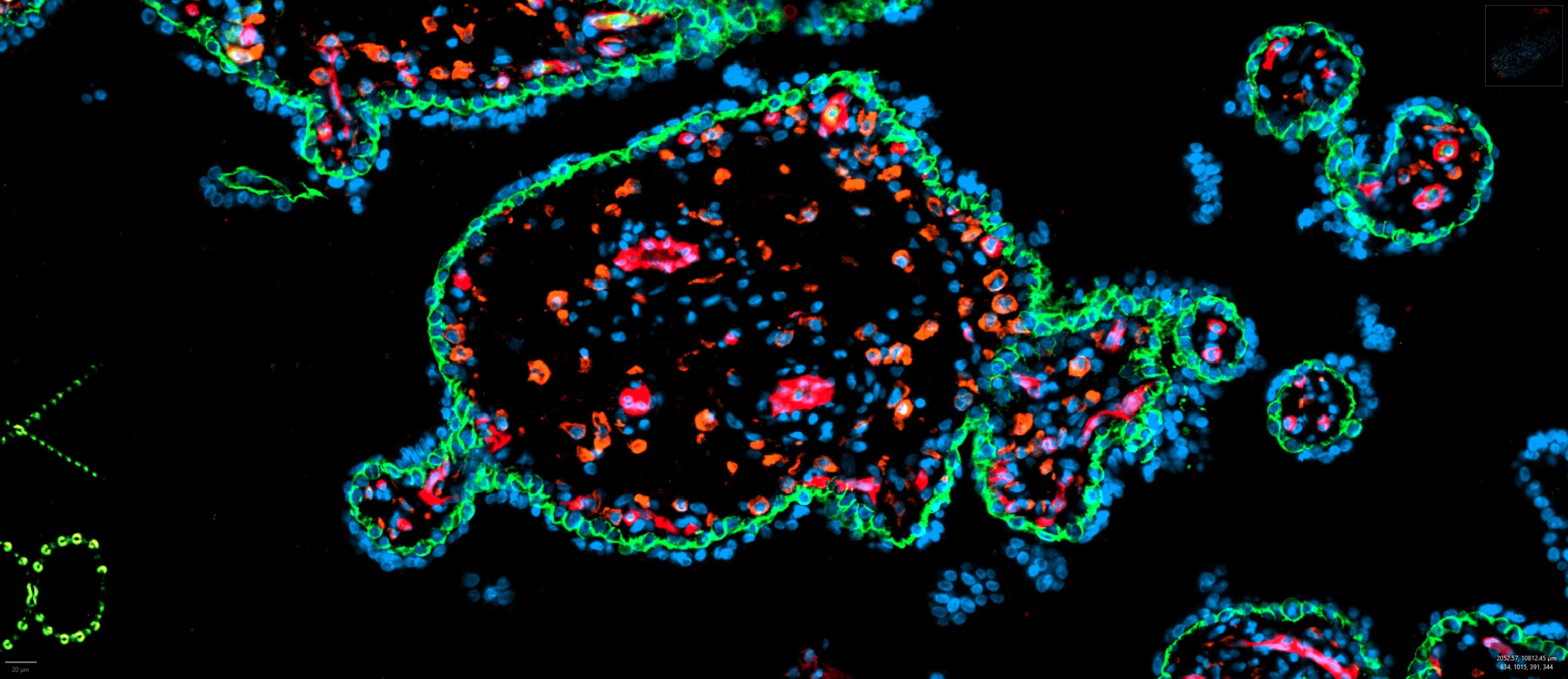
Now researchers led by Dr. Daniela Sofia Valdes in the lab of Dr. Fabian Coscia, group leader of the Spatial Proteomics Lab at the Max Delbrück Center, have found that smoking impairs the placenta within the first few weeks of pregnancy. Two cell types in particular showed pronounced changes in gene activity: a specific type of trophoblast that forms the outer layer of the placenta and comes into direct contact with maternal blood, and a specialized type of immune cell found in the placenta. The study is published in "Cell Systems."
"Even before our study, we knew that smoking disrupts the function of the placenta, which supplies the developing baby with oxygen and nutrients, among other things," says Dr. Florian Herse from the Hypertension-caused End-Organ Damage Lab at the Experimental and Clinical Research Center (ECRC), headed by Drs. Dominik Müller and Ralf Dechend. The ECRC is a joint institution of Charité—Universitätsmedizin Berlin and the Max Delbrück Center. Herse is a corresponding author of the study along with Coscia. Valdes conducted the study while she was a doctoral student in Herse's lab.
"We first examined placental tissue from women who smoked and those who did not during the first trimester of pregnancy," explains Valdes.
Source link





