
This article has been reviewed according to Science X's editorial process and policies. Editors have highlighted the following attributes while ensuring the content's credibility:
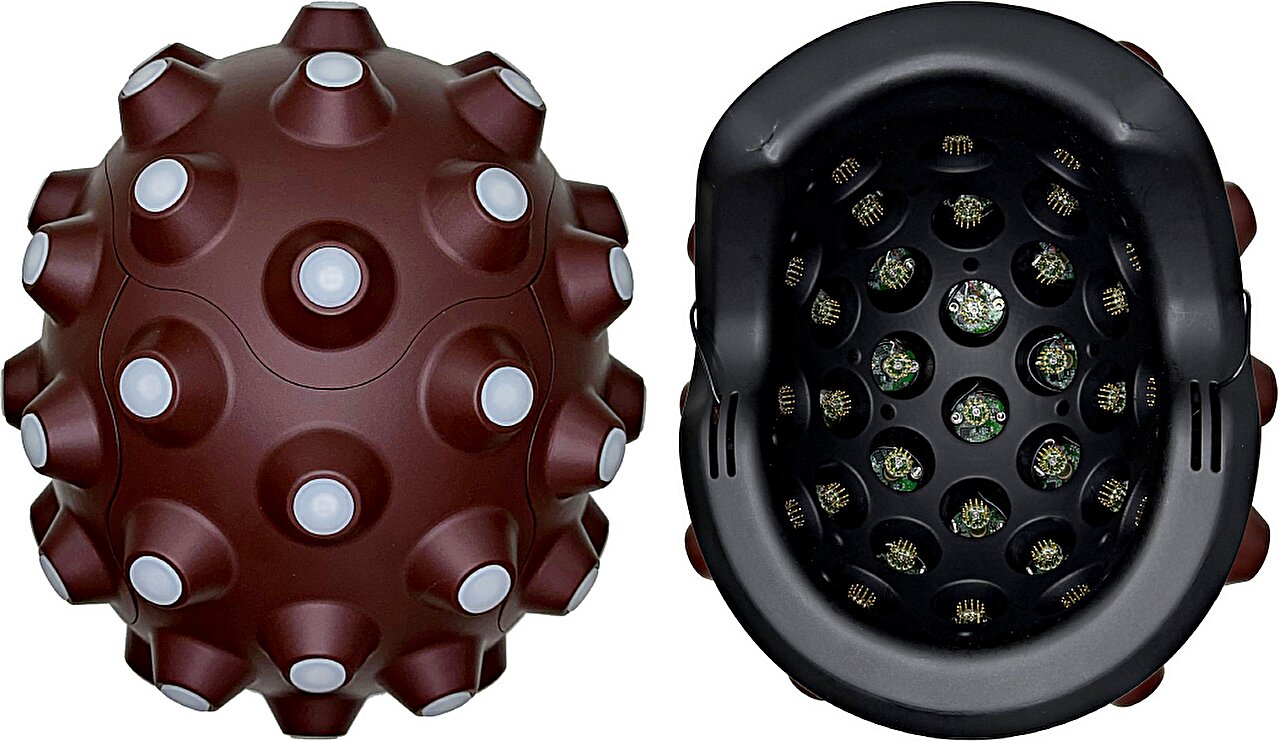
A self-adjusting electroencephalography (EEG) monitoring helmet has been developed to enable easier and more reliable brainwave measurements in various fields, including clinical settings, rehabilitation and brain–computer interfaces (BCIs). The helmet monitors electrode–scalp contact conditions in real time and automatically adjusts electrode positions to maintain stable contact. By reducing measurement variability caused by differences in users' head shapes and hair conditions, the technology is expected to improve the reliability of EEG measurements.
A research team led by Dr. Seungchan Lee, senior researcher at the Department of Diagnostic Sensors of the Daegu-Gyeongbuk Convergence Research Division at the Korea Institute of Machinery and Materials, developed a helmet capable of simultaneously measuring EEG signals from 32 channels, each sampled at 500 Hz. The system integrates electrode contact detection, mechanical position adjustment and contact verification into a single platform.
The 32 channels enable simultaneous measurement of signals from multiple locations on the scalp, helping identify spatial patterns of brain activity, while the 500 Hz sampling rate allows precise recording of EEG signal changes over time.
The self-adjusting EEG monitoring helmet combines a 32-channel, 500 Hz EEG recording system with automatic electrode position adjustment technology. A weak test signal applied through a bias electrode is used to assess electrode–scalp contact conditions in real time, and electrodes with unstable contact are adjusted vertically to maintain appropriate contact.
The system employs closed-loop control, which stops the movement of each electrode once the target contact condition is reached, along with a real-time contact monitoring algorithm.
Source link





