
This article has been reviewed according to Science X's editorial process and policies. Editors have highlighted the following attributes while ensuring the content's credibility:
Rare sugars are naturally occurring monosaccharides that are scarce in nature and are not readily used by the body as energy sources. Some have physiological effects beyond sweetness, raising interest in their potential health applications. One such sugar, d-sorbose, is a structural relative of d-fructose, but its effects on immune cells have remained unclear. Regulatory T cells (Tregs), identified by the Foxp3 protein, help restrain excessive immune responses and maintain immune balance. Whether a rare sugar can promote these cells has been little explored.
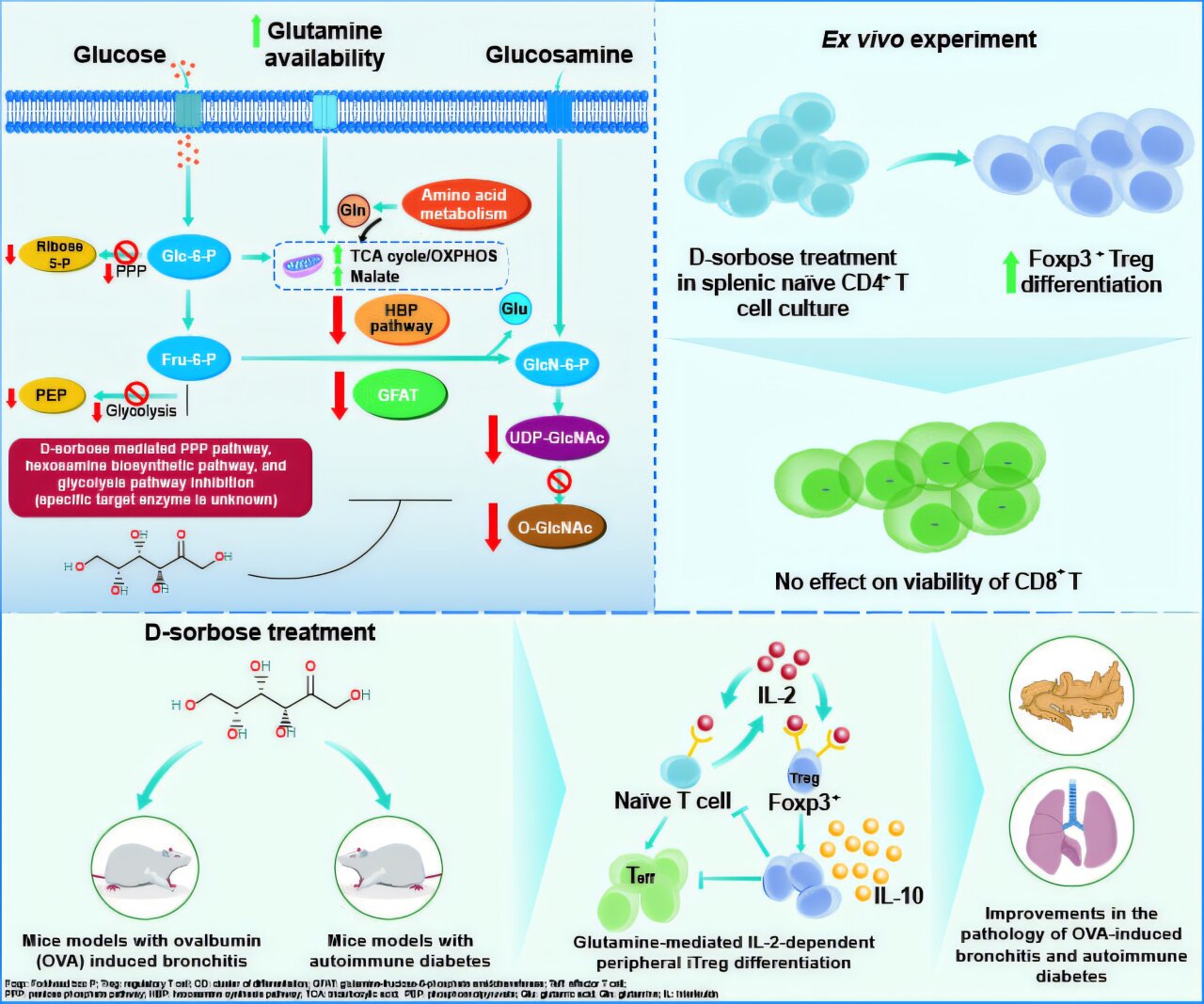
A research team led by professor Masato Hoshi, Dr. Fumiaki Sato and Dr. Kuniaki Saito from the Department of Disease Systems Analysis Medicine, Fujita Health University School of Medical Sciences, Japan, investigated this question. The researchers tested d-sorbose in cultures of mouse naive CD4⁺ T cells and in two mouse models: ovalbumin (OVA)-induced allergic airway inflammation and spontaneous autoimmune diabetes in nonobese diabetic (NOD) mice. They assessed T-cell survival, immune cell activity, tissue changes and intracellular metabolites.
In cell cultures, d-sorbose increased Foxp3⁺ Treg frequency to levels comparable to those achieved with d-mannose, a known Treg-promoting sugar. Unlike d-mannose, d-sorbose did not reduce CD8⁺ T-cell frequency, and it did not compromise T-cell viability. In OVA-challenged mice, d-sorbose increased Treg frequency in the mediastinal lymph nodes and inflamed lungs. These Tregs showed stronger suppressive activity and produced more interleukin-10 (IL-10), an anti-inflammatory molecule.
Source link





