
This article has been reviewed according to Science X's editorial process and policies. Editors have highlighted the following attributes while ensuring the content's credibility:
Many Americans are confused about the risks of measles, as well as the safety and benefits of childhood vaccines, according to a survey of more than 1,000 adults released today by the Annenberg Public Policy Center at the University of Pennsylvania.
The survey was published the same day that Pennsylvania announced its eighth measles-related death, bringing the total number of U.S. measles-related deaths this year to 11. Three people also died from measles last year.
Nearly 60% of respondents didn't know how likely people are to die from measles, according to the Annenberg Science and Public Health survey.
Only one in 10 survey respondents chose "about 1 in 1,000" as the correct death rate for measles, the survey found. The Centers for Disease Control and Prevention (CDC) estimates the death rate from measles as one to three of every 1,000 children infected. Nearly a quarter of those surveyed thought the death rate was lower, while almost 10% thought the mortality rate was higher.
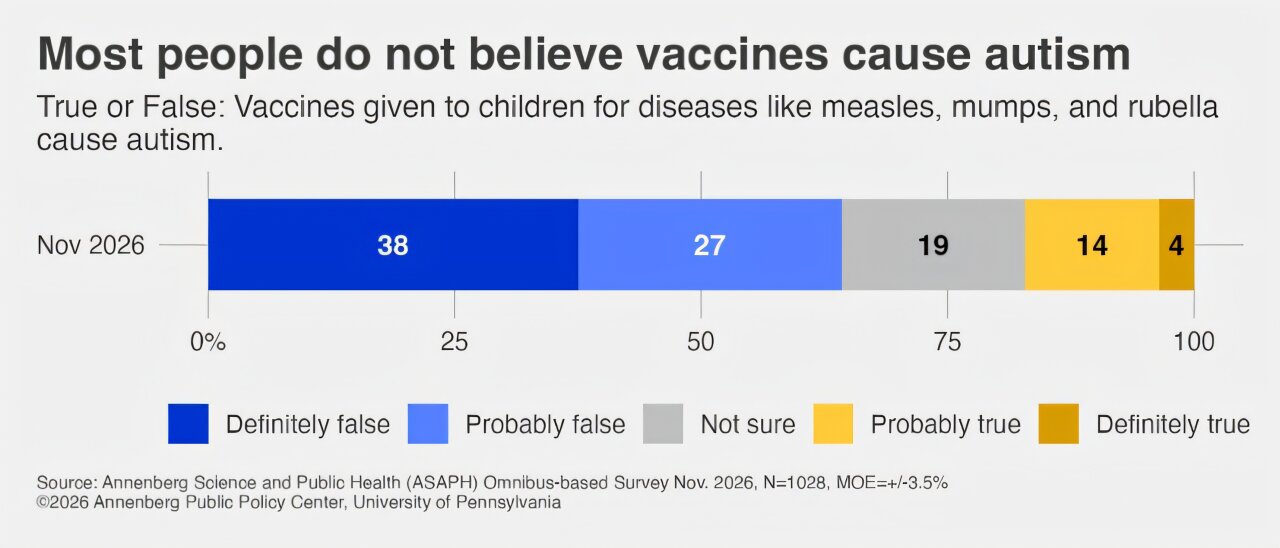
Although 64% of adults disagreed with the false claim that "vaccines given to children for diseases like measles, mumps, and rubella [MMR] cause autism," 17% agreed and 19% weren't sure, according to the survey, conducted from Nov. 6 to Nov. 8.
The survey's margin of sampling error is ± 3.5 percentage points at the 95% confidence level.
Almost half of respondents correctly said that fully vaccinated children are "about as likely" to show signs of autism as those who are not fully vaccinated, 11% thought fully vaccinated children are "more likely," 14% believed they are "less likely," and 26% were not sure.
Source link





