This article has been reviewed according to Science X's editorial process and policies. Editors have highlighted the following attributes while ensuring the content's credibility:
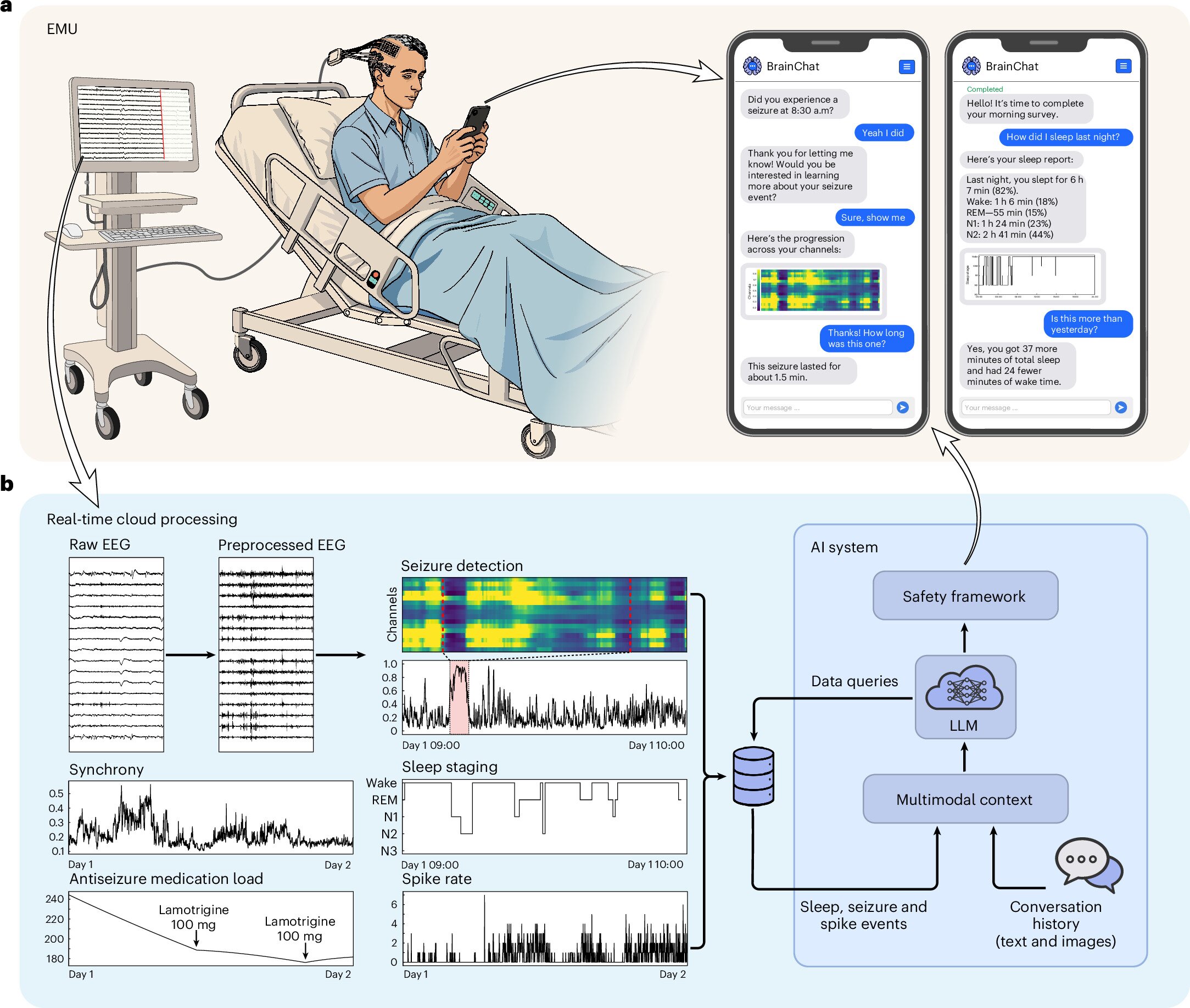
A team has built an AI-based interface that enables real-time communication between patients and epilepsy monitoring devices. As part of a small clinical study at the University of Pennsylvania in Philadelphia, patients used a smartphone application to inquire about their own physiological data and received accurate information in response. In turn, the system learned from patient feedback to improve seizure detection, ultimately reducing its false alarms by about 80%. The research is published in Nature Medicine.
"This proof of concept showcases a technology with the exciting potential to shift management of epilepsy and possibly other diseases in a more adaptive direction that puts patients in the driver's seat," said Amy Bany Adams, Ph.D., acting director of the NIH's National Institute of Neurological Disorders and Stroke (NINDS).
Electroencephalography (EEG) devices are useful for diagnosing epilepsy, as their electrodes, usually placed on or implanted beneath the scalp, can record brain activity indicative of an active seizure or high risk for one. They acquire continuous streams of activity, but in practice, people only see a trickle, as devices generally share data with expert reviewers on a daily or multi-day basis.
"These devices are made first and foremost for doctors; however, they do see a lot of information that patients would benefit from knowing. , a professor of neurology and bioengineering at the University of Pennsylvania.
Source link