
This article has been reviewed according to Science X's editorial process and policies. Editors have highlighted the following attributes while ensuring the content's credibility:
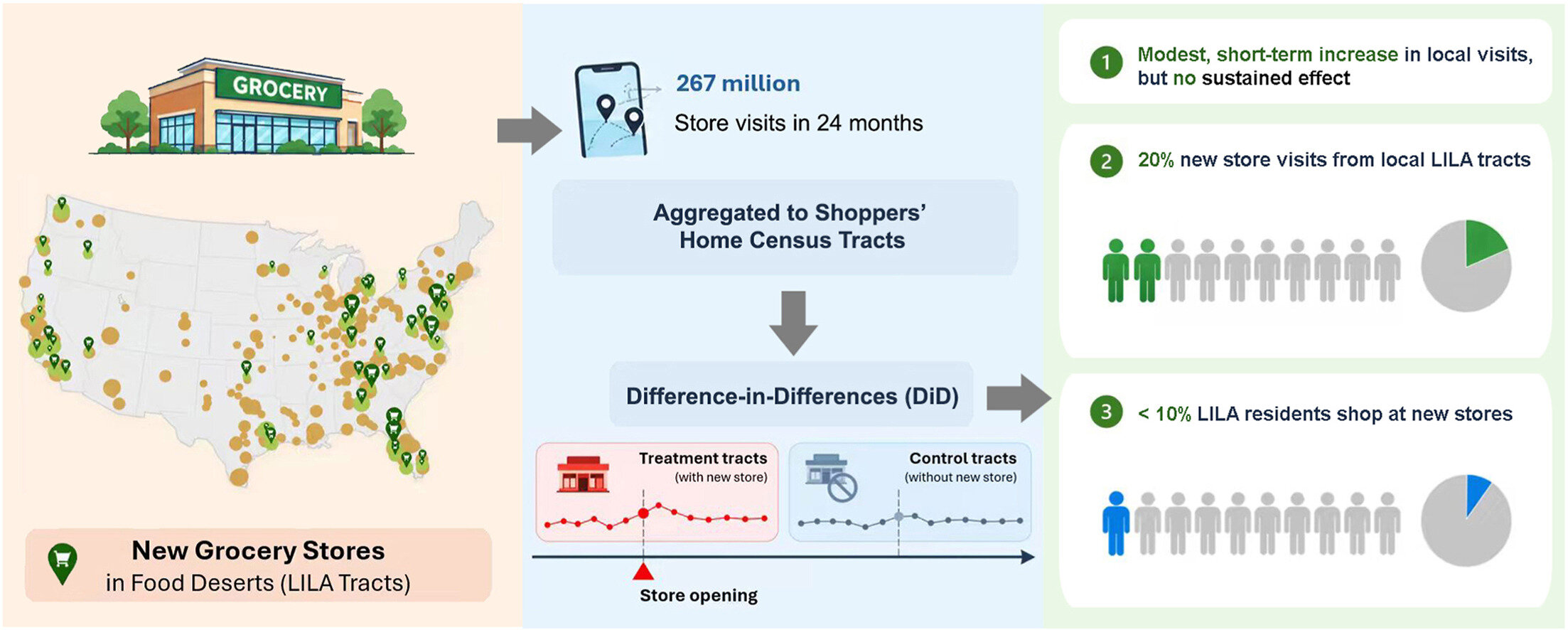
Food deserts, according to the U.S. Department of Agriculture, are low-income neighborhoods where residents have limited access to healthy and affordable food. Opening a grocery store is a commonly proposed solution to improve food access in these areas, but that doesn't necessarily mean residents will shop there.
A nationwide study by researchers at Binghamton University and the University of Connecticut reveals that residents of low-income areas account for less than 20% of visits to newly opened stores in food deserts. The findings suggest that simply adding new stores isn't an adequate solution to the food access crisis in low-income areas.
The study, published in the journal Applied Geography, is the result of a collaborative, multidisciplinary effort that includes Binghamton University Assistant Professor of Geography Congcong Miao; UConn Associate Professor of Geography, Sustainability, Community and Urban Studies Xiang Chen; and UConn Associate Professor of Allied Health Sciences Ran Xu. Miao and Chen are geographers, while Xu is a biostatistician in public health.
"Since my PhD program, my research has focused on spatial data science and geospatial computational methods with applications in urban transportation, human mobility, and related issues such as spatial accessibility and health disparity," said Miao, who joined Binghamton this fall.
A series of government policy initiatives — including the 2014 Farm Bill — sought to address food insecurity by encouraging the establishment of grocery stores in food-desert areas.
Source link





