
This article has been reviewed according to Science X's editorial process and policies. Editors have highlighted the following attributes while ensuring the content's credibility:
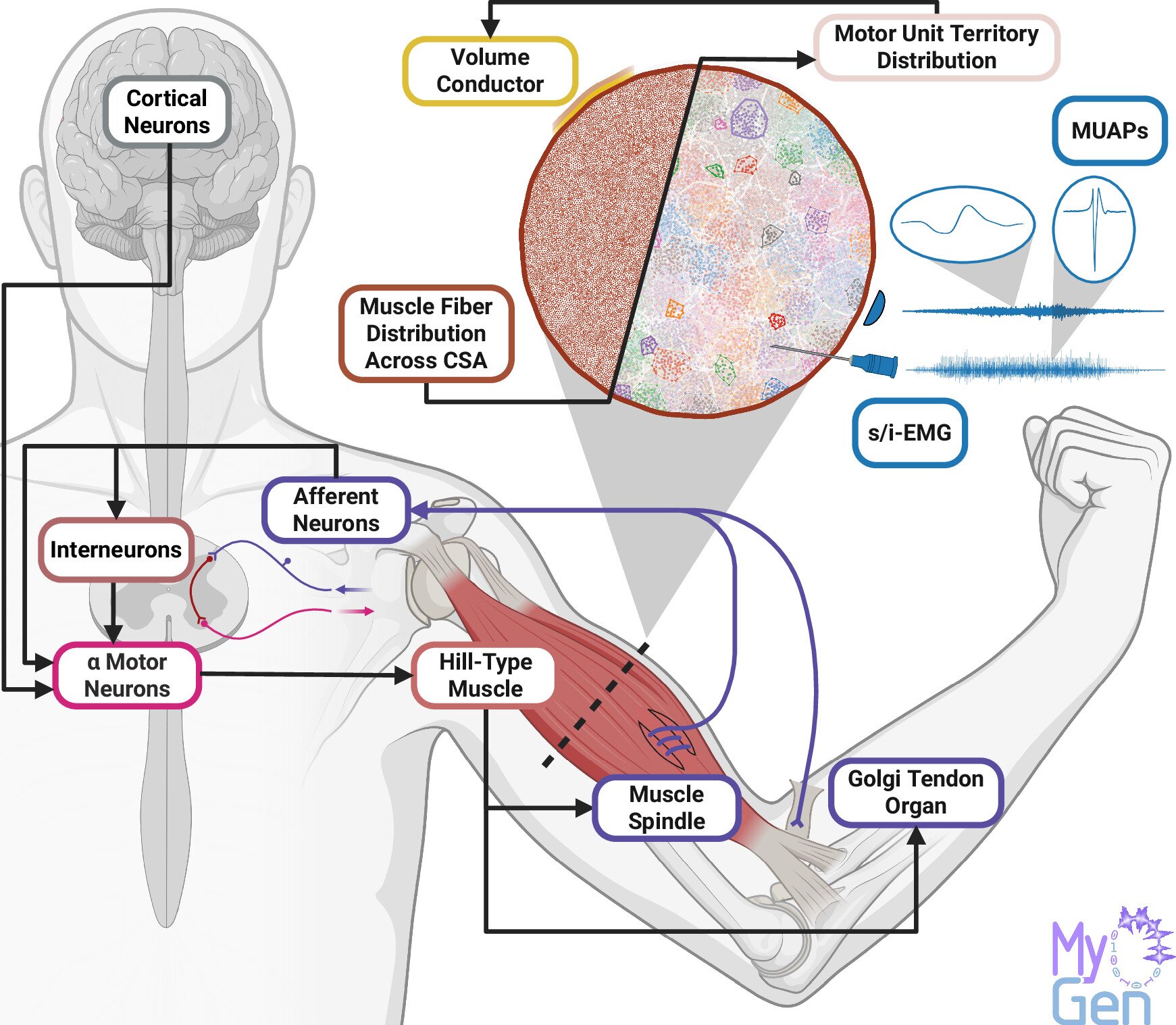
Immense progress has been made in recent years in developing assistive systems for people who are paralyzed. However, the underlying neuromotor processes—from the brain's commands through the neural circuits in the spinal cord to the activation of the muscles—have so far been mostly studied in isolation. Researchers at Friedrich-Alexander-Universität Erlangen-Nürnberg (FAU) and their partners in Brazil have developed the MyoGen platform, which integrates these processes into a single simulation. The model, presented in the journal Nature Communications, is freely accessible and is intended to support both clinical research and the optimization of medical devices.
Capturing and interpreting electrical signals from muscle activity is the key to developing wearable assistive systems. "Spinal cord injuries often lead to paralysis of the limbs because important signaling pathways from the brain to the muscles no longer function," says Raul Sîmpetru of the Neuromuscular Physiology and Neural Interfacing Laboratory (N-squared Lab) at FAU. "However, the neural connections are not always completely interrupted, which is why residual muscle activity can be measured with electrodes."
During his doctoral research, Sîmpetru investigated how electromyography can be used for AI-driven assistive systems. The N-squared Lab develops such devices, including orthoses that help people with impaired hand function grasp objects.
Despite significant progress, the fundamental mechanisms of neuromotor control are still not fully understood. Sîmpetru of FAU and Ricardo G. Molinari of Universidade Estadual de Campinas (Unicamp) in Brazil pooled their expertise in data modeling and experimental research to develop the MyoGen platform.
Source link





