
This article has been reviewed according to Science X's editorial process and policies. Editors have highlighted the following attributes while ensuring the content's credibility:
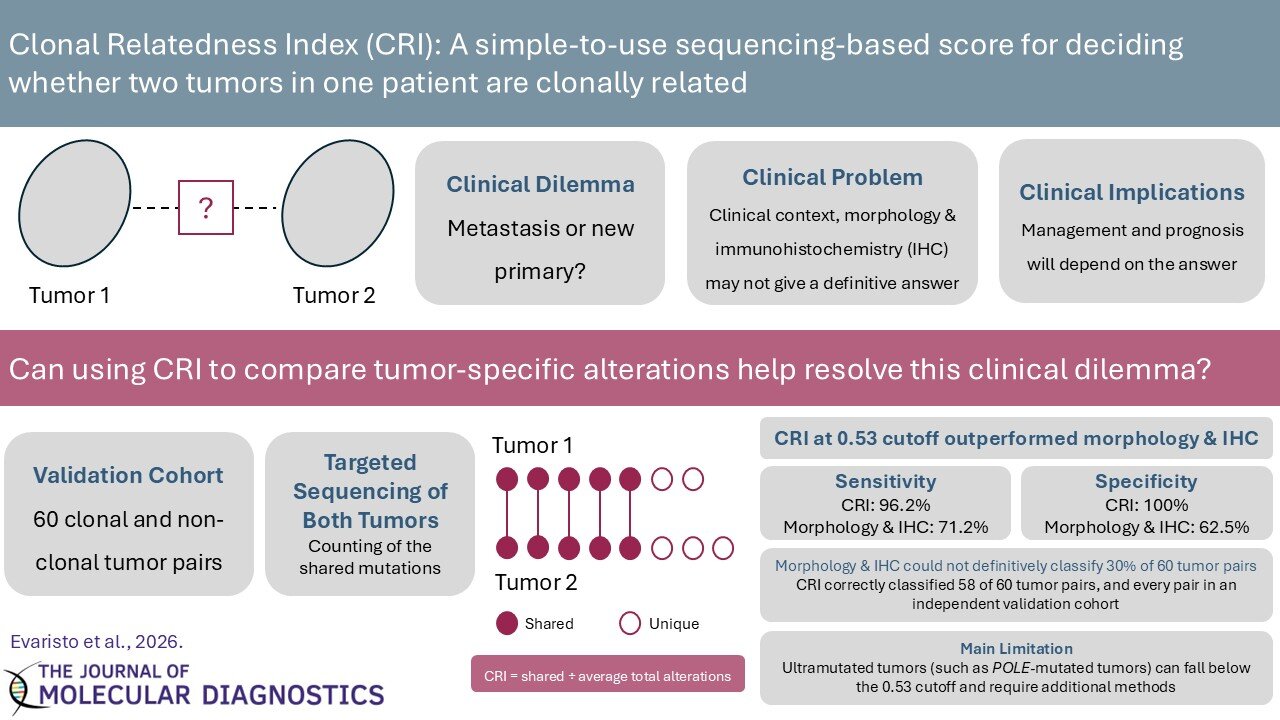
Research has found that the newly developed Clonal Relatedness Index (CRI) can accurately determine whether tumors in the same patient share a common clonal origin. The findings, detailed in an article appearing in The Journal of Molecular Diagnostics, have important implications for the clinical management of complex cases of cancers of the digestive system and abdominal lining, specifically gastrointestinal, hepatopancreatobiliary and peritoneal carcinomas.
"When two tumors arise in the same patient, one of the most crucial questions is whether they are related or represent independent primaries," explains lead author Namrata Setia, M.D., Department of Anatomic Pathology, University of Chicago. "This is particularly challenging when tumors in different organs share overlapping cellular features, or when genomic complexity limits the diagnostic clarity of conventional markers. Even experienced pathologists can reach the limits of microscopic and marker-based evaluation."
The researchers of this study analyzed 60 pairs of gastrointestinal, hepatopancreatobiliary and peritoneal tumors using targeted next-generation sequencing (NGS) data and developed the CRI, which is calculated as the number of shared genomic alterations divided by the average number of alterations in the two tumors. CRI outperformed conventional phenotype-based assessment in distinguishing whether a tumor has metastasized or whether it represents a new independent lesion.
, Department of Anatomic Pathology, University of Chicago, and Department of Pathology, McGill University, adds, "Unlike more complex statistical approaches that require specialized software or biostatistical expertise, we aimed to turn genomic data that laboratories already generate into a simple, quantitative measure of tumor relatedness.
Source link





