
This article has been reviewed according to Science X's editorial process and policies. Editors have highlighted the following attributes while ensuring the content's credibility:
Germany's COVID-19 traffic light is red, and the number of infections is high. But how well is the population protected against the virus variants currently circulating? The new SARS-CoV-2 variant PJ.2.1 has been spreading since May and has long since reached Europe. It traces back to an older viral lineage that has since largely disappeared from the infection landscape. However, the virus likely persisted in a person with a long-term infection and underwent significant changes through numerous mutations.
Researchers from the Infection Biology Unit at the German Primate Center—Leibniz Institute for Primate Research, in collaboration with colleagues from Hannover Medical School, investigated how efficiently PJ.2.1 can penetrate human cells and how well antibodies from vaccinated individuals neutralize the new variant.
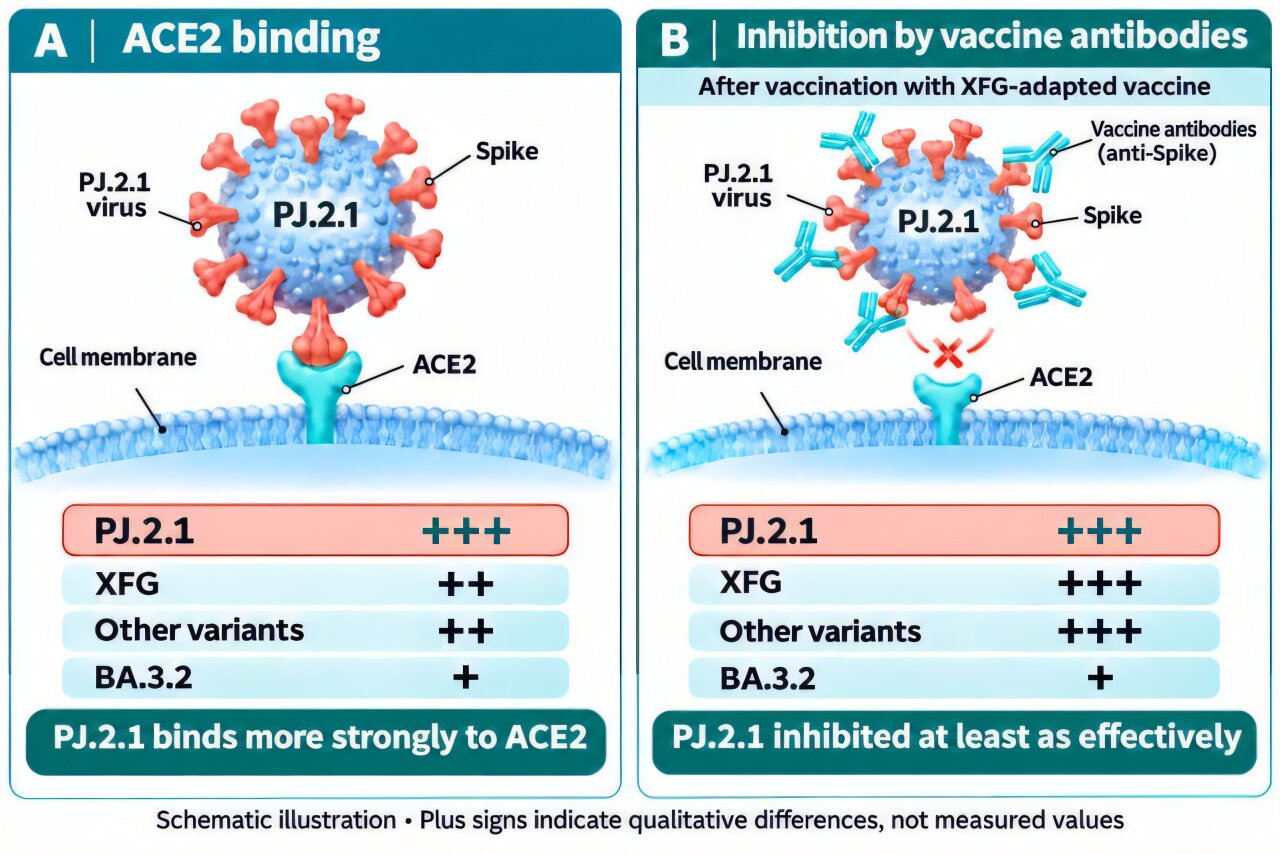
The results show that PJ.2.1 binds more strongly than the other virus variants studied to the ACE2 receptor, which serves as the entry point for SARS-CoV-2 into human cells, and enters certain cells that produce only small amounts of ACE2 more effectively.
Despite these changes, the new variant was effectively neutralized by antibodies produced following vaccination with the current booster vaccine, which has been adapted to the XFG variant. The results suggest that vaccination provides protection against PJ.2.1. However, this could change if the variant acquires additional mutations that enable it to evade the immune response.
The findings have been published in the Journal of Infection and The Lancet Infectious Diseases .
Source link





