This article has been reviewed according to Science X's editorial process and policies. Editors have highlighted the following attributes while ensuring the content's credibility:
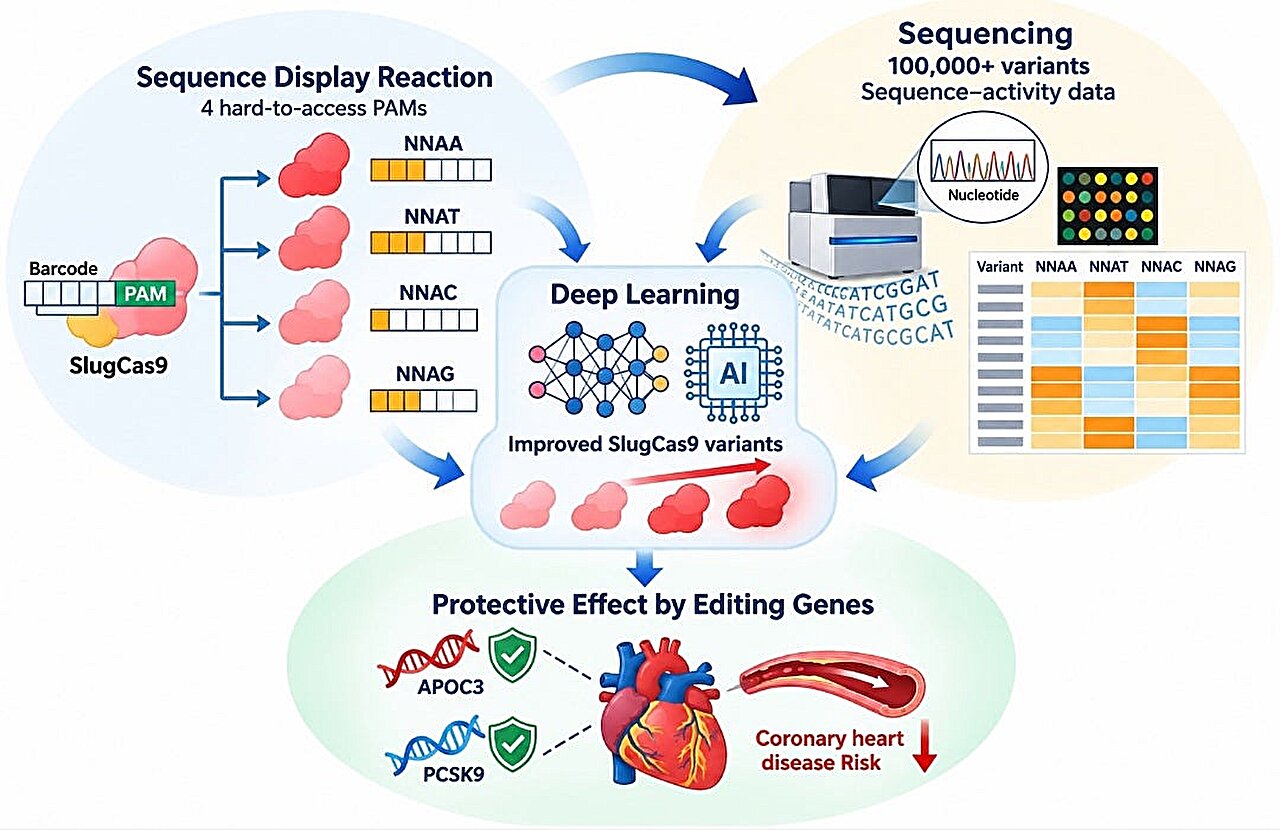
Rice University's Han Xiao has used his AI-supported Sequence Display technology to expand the targeting abilities of CRISPR/Cas9. In a paper recently published in Nature Communications, Xiao evolved several variants of a compact Cas9 that could efficiently target stretches of DNA previously inaccessible for editing. The research included a proof-of-concept study in which the evolved Cas9s were successfully used to edit two genes found in coronary heart disease.
"My team used Sequence Display technology to evolve a compact Cas9 that can efficiently target priority areas of DNA," said Xiao, a professor of chemistry and corresponding author on this paper. "This shows the power of our approach, which rapidly generates large datasets that AI can use to identify optimal protein sequences for a given function. In this case, it allowed us to evolve several new Cas9 variants with better activities."
Cas9, the CRISPR enzyme, works by attaching to a protospacer adjacent motif, or PAM, in DNA. This short stretch of DNA, which can be between two and six base pairs long, acts somewhat like a docking station for the enzyme. Once the Cas9 enzyme recognizes a suitable PAM, it can then edit the DNA as dictated by a guide, ultimately editing an adjacent target DNA sequence that matches the guide RNA.
Edits made by CRISPR, therefore, have to be made within a certain distance, measured in base pairs, of a PAM.
Source link