
This article has been reviewed according to Science X's editorial process and policies. Editors have highlighted the following attributes while ensuring the content's credibility:
A study in mice that involved University of Manchester scientists has revealed that eye damage linked to a rare inherited childhood disease may begin remarkably early and worsen progressively over time. The team investigated deficiency in an enzyme called HGSNAT, the root cause of a devastating genetic childhood neurological disease called MPSIIIC, which produces progressive damage to the brain but can also affect vision. The findings are published in Investigative Ophthalmology & Visual Science.
Recently, deficiency of HGSNAT has also been linked to a form of retinitis pigmentosa, a disease affecting only the eyes that causes a progressive reduction in sight. The loss of HGSNAT in these patients leaves cells unable to properly break down a complex sugar known as heparan sulfate. As this material accumulates inside cells, it can cause increasingly severe neurological and retinal problems.
Although retinal degeneration has been reported in patients with HGSNAT deficiency, scientists do not yet fully understand when the damage begins or how it progresses.
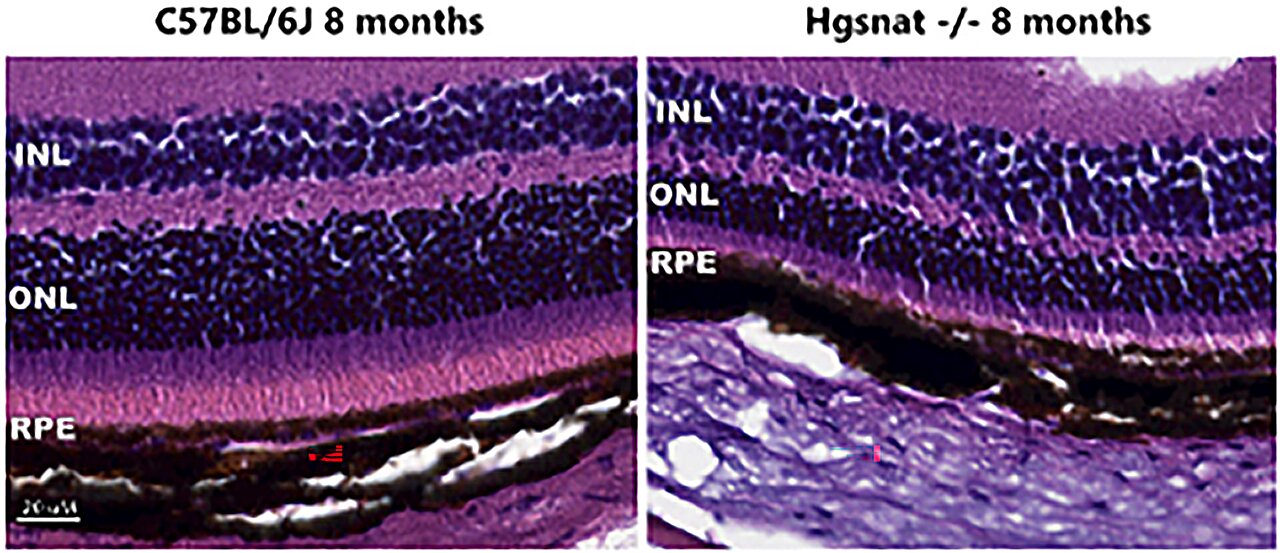
To investigate, the team studied mice genetically engineered to lack HGSNAT and compared their eyes with those of healthy mice at different ages. Using high-resolution optical coherence tomography, a scanning technique widely used to examine the retina, the researchers detected degeneration of photoreceptors in the affected mice from just 2 months of age. Photoreceptors are specialized cells at the back of the eye that detect light and are essential for vision.
Source link





