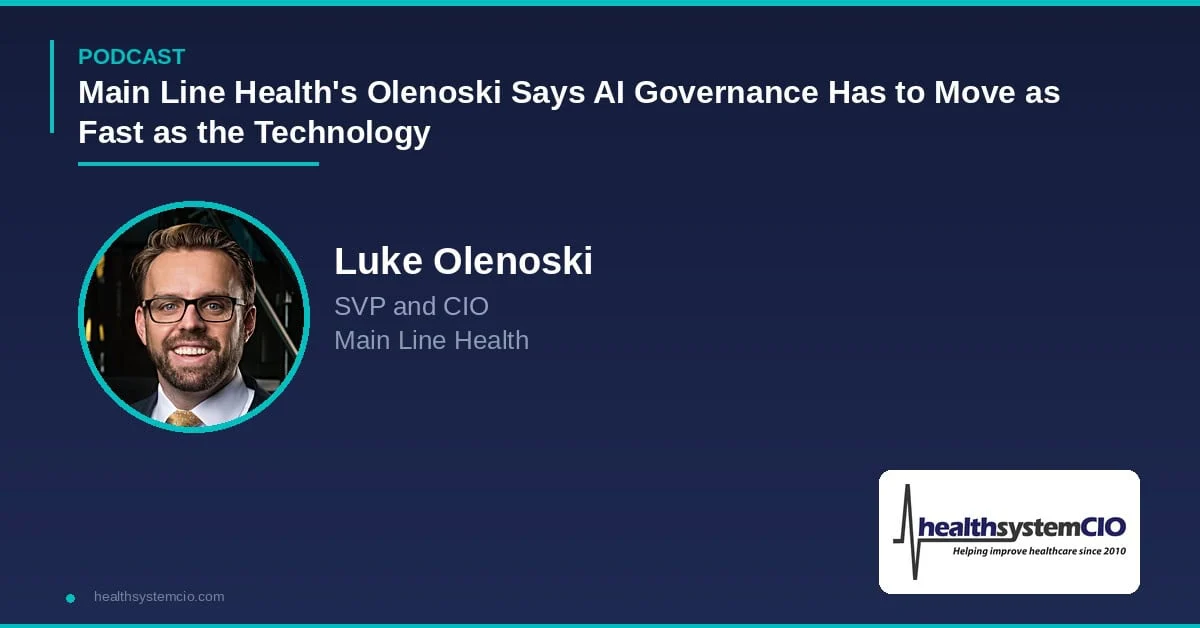
Main Line Health SVP and CIO Luke Olenoski explains how his team assigns AI decisions, equips 14,000 staff with AI tools and tracks usage-based costs. Watch below or on YouTube.
A health system that reviews AI on a quarterly governance calendar cannot keep up with the technology’s pace of change, according to Luke Olenoski, SVP and CIO at Main Line Health. On a recent episode of the healthsystemCIO Show, he described how the Philadelphia-area system built its AI program on three pillars: education, policy and regulation, and tracking adoption and use cases. The pillars match the work streams of the AI council Olenoski described to healthsystemCIO in July 2025. He described Main Line Health as a $3 billion integrated network with about 14,000 team members. To keep pace, it settled who decides AI questions and folded AI review into existing intake. It also pushed training through peer networks, so adoption does not wait on the help desk.
The policy pillar carries the least glamour and keeps the organization out of trouble, Olenoski said. Much of that work went into settling decision rights. His team worked with clinical, privacy, compliance and legal leaders to set the rules of the road. They also worked out who decides whether to evaluate a new tool or to switch an external large language model on or off. The pace of change drove that choice. In fact, he estimated that 25 to 40 percent of his daily email connects to AI.
“This is not something where you can just meet quarterly or every six months for governance,” Olenoski said.
Source link