This article has been reviewed according to Science X's editorial process and policies. Editors have highlighted the following attributes while ensuring the content's credibility:
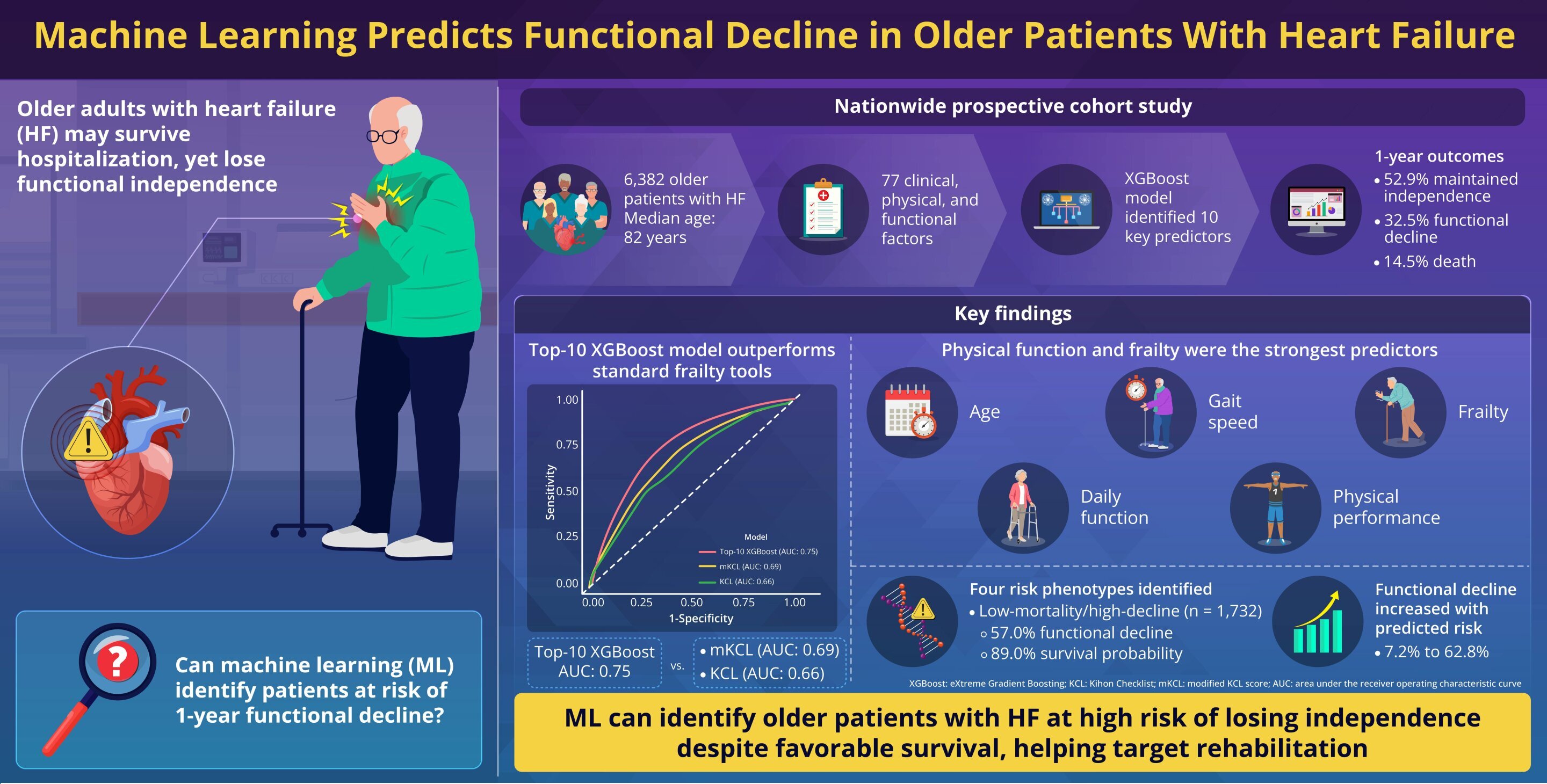
For older adults with heart failure (HF), leaving the hospital alive does not always mean returning to an independent life. Loss of independence can reduce quality of life, increase caregiver burden and raise care needs. Yet most prognostic approaches focus on death or rehospitalization, making it difficult to identify patients likely to survive while losing independence.
Addressing this challenge, a research team led by assistant professor Kanji Yamada from the Department of Physical Therapy, Faculty of Health Science, Juntendo University, Japan, including associate professor Nobuyuki Kagiyama and specially appointed professor Tetsuya Takahashi, both from the same university, analyzed 6,382 patients aged 65 years or older who were hospitalized for HF, received physical therapy and were independent in activities before admission.
Using the prospective J-Proof HF Registry, they developed an eXtreme Gradient Boosting (XGBoost) model to predict functional maintenance, functional decline or death one year after discharge. The study was published online in the Journal of Cardiac Failure on Aug. 20, 2026.
The team used 77 candidate predictors. The model incorporated assessments performed by physical therapists at discharge, including maximum gait speed, the Short Physical Performance Battery (SPPB), handgrip strength and the Barthel Index (BI), as well as preadmission frailty measured by the Kihon Checklist (KCL). A parsimonious Top-10 model was evaluated using nested leave-one-site-out validation and compared with KCL-based scores.
At one year, 2,076 patients experienced functional decline and 928 died, while 3,378 maintained functional independence.
Source link