
This article has been reviewed according to Science X's editorial process and policies. Editors have highlighted the following attributes while ensuring the content's credibility:
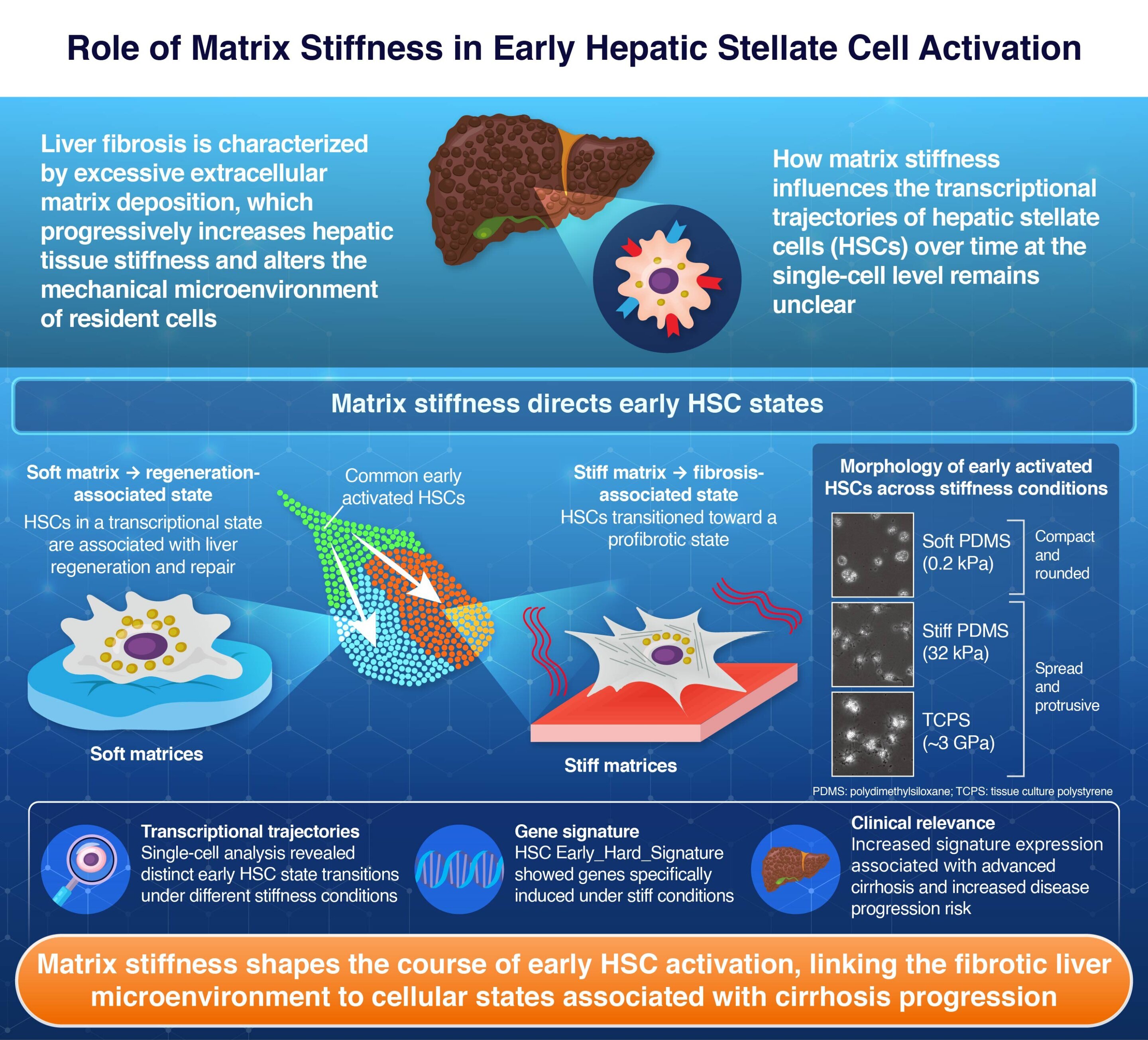
Soft and stiff extracellular matrix environments influence how hepatic stellate cells (HSCs) respond during liver injury. Researchers from Science Tokyo investigated how matrix stiffness shapes the direction of HSC activation. They revealed that soft conditions favored regeneration-associated cellular states, while stiff conditions promoted fibrosis-associated gene expression.
They also identified a gene-expression program, HSC Early_Hard_Signature, associated with cirrhosis severity and disease progression, offering insights into potential biomarkers and therapeutic strategies for chronic liver disease.
The liver is constantly exposed to injury and must balance tissue repair with the prevention of excessive scarring. The liver's extracellular matrix (ECM) provides structural support to cells and influences their behavior through mechanical signals.
In a healthy liver, the ECM is relatively soft, but chronic liver injury can lead to excessive ECM accumulation, increasing tissue stiffness. This stiffening is characteristic of liver fibrosis, which can further progress to cirrhosis, a condition with extensive scarring and impaired liver function.
Hepatic stellate cells (HSCs) are key to the process of liver tissue stiffening. Liver injury activates HSCs to produce ECM components, including collagen, contributing to further tissue stiffening. Although this relationship between matrix stiffness and fibrosis is well recognized, the role of the mechanical environment during the earliest stages of HSC activation and the influence on their subsequent cellular states remain poorly understood.
To address this question, a research team led by professor Sei Kakinuma of the Department of Clinical and Diagnostic Laboratory Science, professor Yasuhiro Asahina, lecturer Masato Miyoshi, graduate student Kento Inada, and professor Ryuichi Okamoto of the Department of Gastroenterology and Hepatology, Graduate School of Medical and Dental Sciences at the Institute of Science Tokyo (Science Tokyo), Japan, investigated how the microenvironment surrounding liver cells, particularly the stiffness of ECM, influences the activation process of HSCs, which play a central role in liver fibrosis.
Source link





