
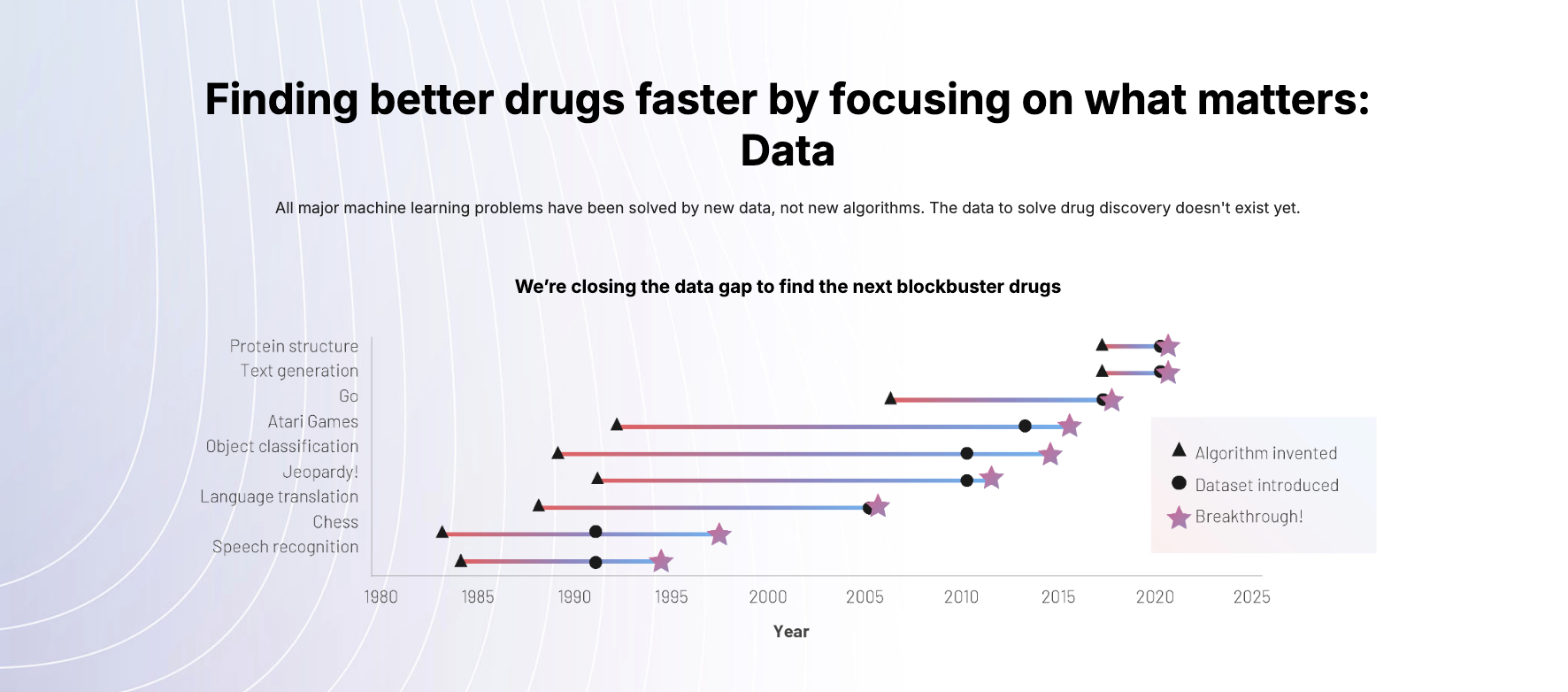
Rather than scraping fragmented historical literature, Leash operates an automated physical laboratory in Salt Lake City purpose-built to generate uniform, machine-learning-grade biochemical measurements at scale.
To date, Leash has designed and physically screened 6.3 million proprietary molecules against nearly 1,000 protein targets, producing more than 44 billion experimental measurements. By capturing standardized ground-truth outcomes across millions of compound-protein pairs, the dataset equips AI models to learn underlying chemical and biological causality rather than memorizing narrow historical hits.
In October, Leash launched Minos, a suite of interactive virtual research environments built directly on its physical laboratory measurements. Within its first six weeks, AI agents executed roughly 100,000 independent experimental campaigns inside Minos at compute speed—exposing critical reasoning flaws in leading frontier models, including persisting with unproductive experimental paths and failing to update strategies when empirical evidence contradicts prior assumptions. Alongside releasing a public research preprint, selected environments, and thousands of agent scientific narratives, Leash plans to publish follow-on results demonstrating substantial model performance gains trained within these environments.
“Most companies developing AI for drug discovery rely on scientific data that was collected to find a drug, not to train models. We are creating a school for AI scientists by generating data for their curriculum,” said Ian Quigley, CEO and co-founder, Leash Biosciences. “Our automated laboratory allows us to design and physically test many millions of molecules against hundreds of proteins, generating the experimental measurements and environments AI models need to learn about biology.
Source link





