
This article has been reviewed according to Science X's editorial process and policies. Editors have highlighted the following attributes while ensuring the content's credibility:
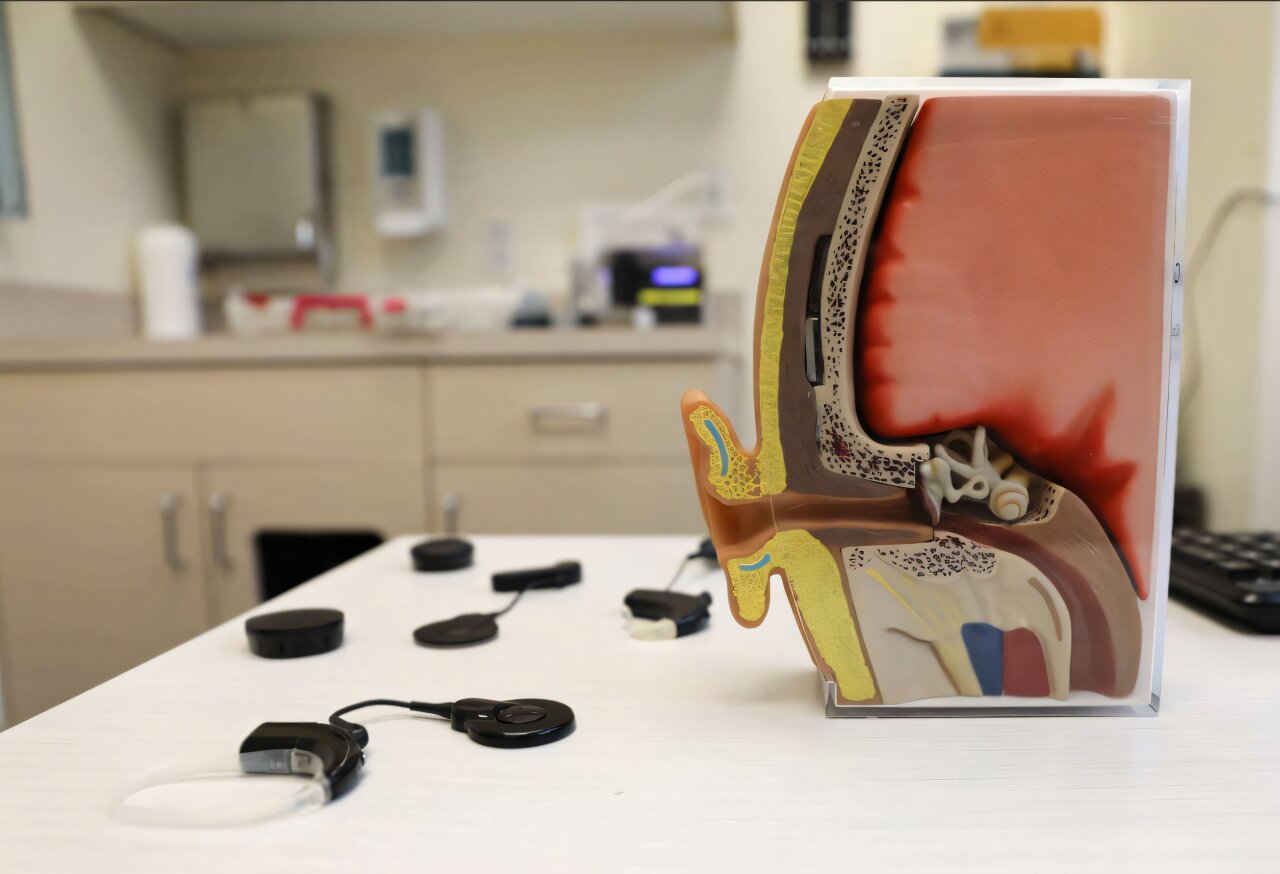
New research offers a new understanding of how the inner ear processes sound, which could lead to improvements in hearing technology like cochlear implants.
The study, published in the journal Science Advances, included collaborators at Oregon Health & Science University, Linköping University in Sweden, the University of Michigan and the University of Washington.
Prevailing theory holds that the cochlea picks up different frequencies as if they're keys on a piano: High frequencies ping the microscopic hair cells on one end of the coil-like membrane while low frequencies activate the other end. This pattern enables detection of frequencies exceeding the speed of neurons. That assumption forms the basis of the technology behind cochlear implants, which are used worldwide to help people with hearing impairments.
In guinea pigs, researchers were able to measure low-frequency vibrations not just in one particular spot on the cochlea, but almost simultaneously across distant regions.
Researchers said the finding suggests an opportunity to improve the design of cochlear implants so that people can pick up the rich complexity of vibrations across the cochlea that the brain translates into sound. High-frequency hearing is typically easier to study in research, whereas low-frequency hearing is much more challenging to study.
The new study suggests the "place code" understanding of hearing may be insufficient to fully reflect the complexity of sound.
"Cochlear implants are geared to take advantage of a place code," said lead author George Burwood, a research instructor in the Oregon Hearing Research Center at OHSU.
Source link





