
This article has been reviewed according to Science X's editorial process and policies. Editors have highlighted the following attributes while ensuring the content's credibility:
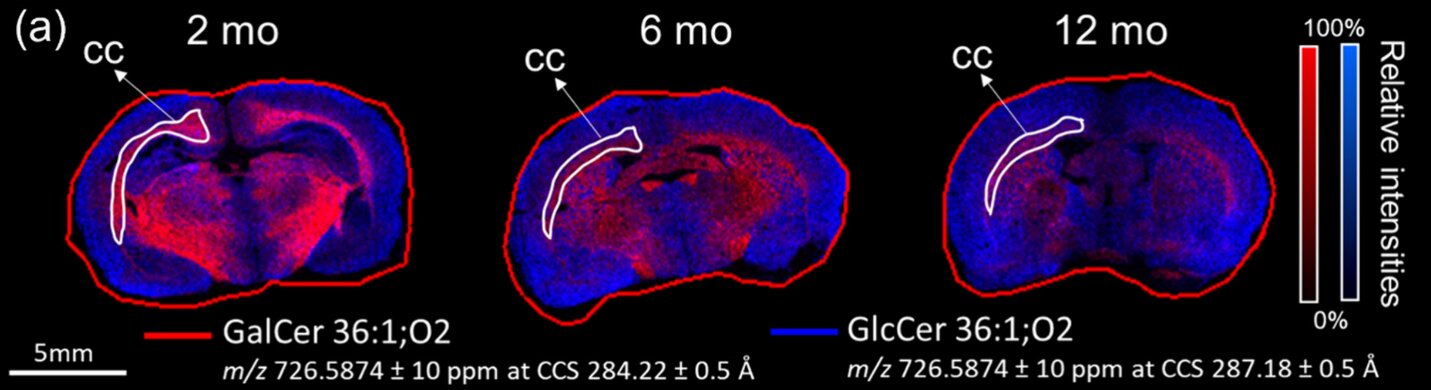
Hsi-Chun Chao, a postdoctoral researcher at the Beckman Institute for Advanced Science and Technology at the University of Illinois Urbana-Champaign, developed a new methodology to map the locations of and differentiate nearly identical molecules in the brain.
With professor Johnathan Sweedler and professor Fan Lam, Chao recently published a paper about this research in the ACS Central Science journal. In the article, Chao and his team applied their method to study changes to these small molecules as the brain develops with age.
"I want to encourage everyone to look beyond famous biomarkers," Chao said. "Sometimes the minor molecules are also important to study as they play important roles and can lead to significant growth in biological research."
The brain is a complex, lipid-rich environment. Lipids are fatty compounds, and glycolipids, a class of lipids conjugated with sugar molecules, play essential roles. Brains rely on glycolipids to organize their cellular membranes and allow communication.
Metabolism is a broad term for the energetic processes that change the form of molecules by either building on or breaking off parts of the molecule. Glycolipids and other molecules go through individually specific metabolic pathways and affect various functions in the body, from movement to speech. Some molecules are similar. When two molecules share the same elemental components and mass but have different structural organization, they're called isomers.
Source link





