
This article has been reviewed according to Science X's editorial process and policies. Editors have highlighted the following attributes while ensuring the content's credibility:
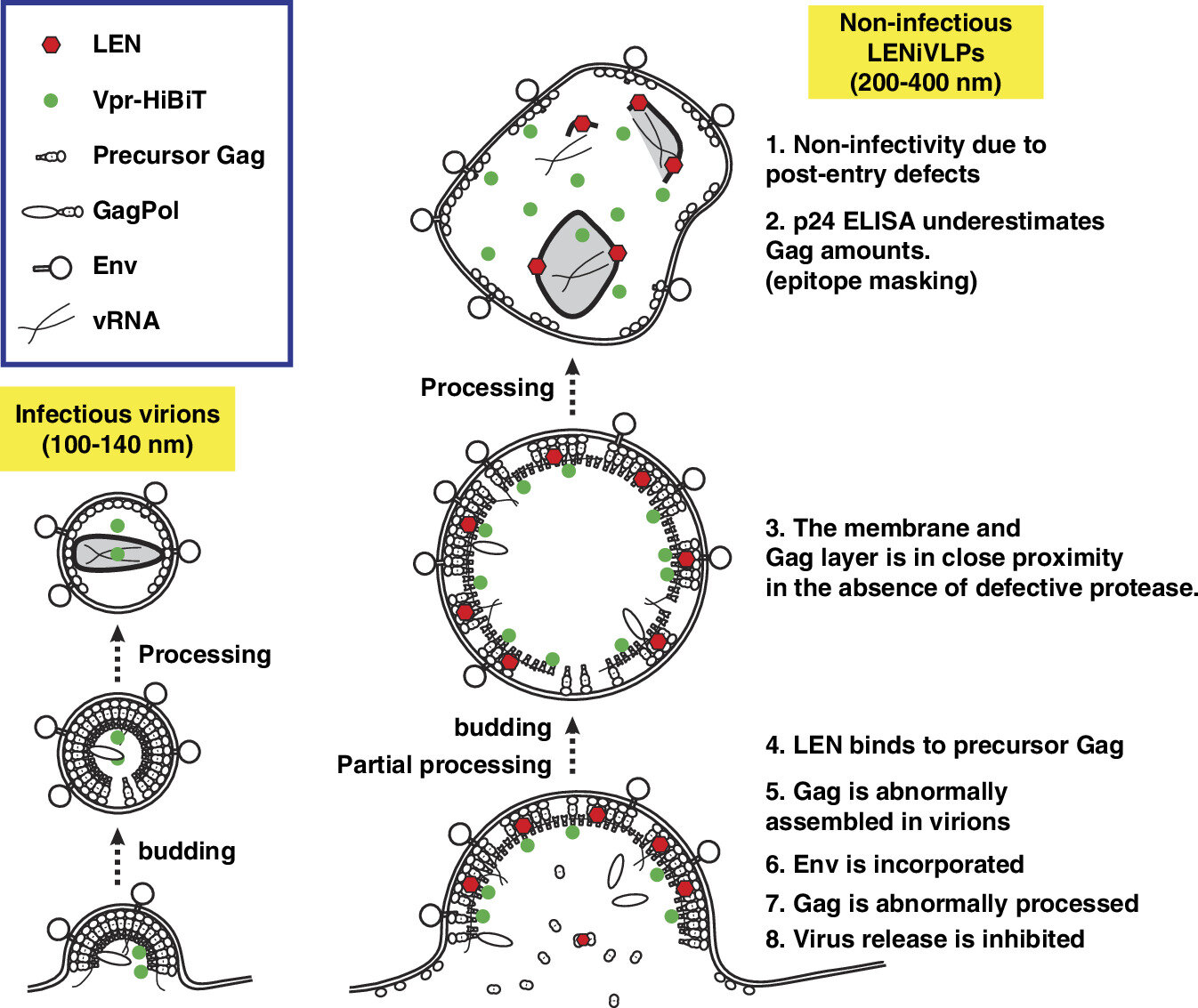
Lenacapavir is a powerful, long-acting drug used to prevent and treat HIV infection. While it is known to block key steps in the virus's replication after entering a cell, researchers have now uncovered another way the drug works: it disrupts the formation of new virus particles, causing them to become abnormally large and noninfectious.
The study, published in Proceedings of the National Academy of Sciences, was conducted through a collaboration involving Kumamoto University, Hamamatsu University School of Medicine, the University of Miyazaki, the National Hospital Organization Nagoya Medical Center and Tokyo University of Technology.
Led by lecturer Kazuaki Monde of Kumamoto University and Professor Yasumasa Iwatani of Hamamatsu University School of Medicine, the research team investigated how lenacapavir affects HIV-1 during the late stages of its life cycle, when new virus particles are assembled and released from infected cells.
The researchers found that lenacapavir binds not only to the mature capsid protein but also to its precursor, a protein called Gag, which helps build new virus particles. This interaction disrupts normal particle assembly and promotes the formation of unusually large virus-like particles measuring more than 200 nanometers in diameter—considerably larger than typical HIV particles, which are generally around 100–130 nanometers.
"An important and unexpected finding of our study is that lenacapavir can bind to both precursor Gag and mature Gag, despite differences in their structures and assembly states," said Monde.
Source link





