
This article has been reviewed according to Science X's editorial process and policies. Editors have highlighted the following attributes while ensuring the content's credibility:
Researchers who study the cellular mechanisms that lead to uncontrolled immune responses that cause certain devastating diseases have discovered a molecular mechanism that can sway whether the body survives severe, life-threatening inflammation. The new study appears in the Proceedings of the National Academy of Sciences.
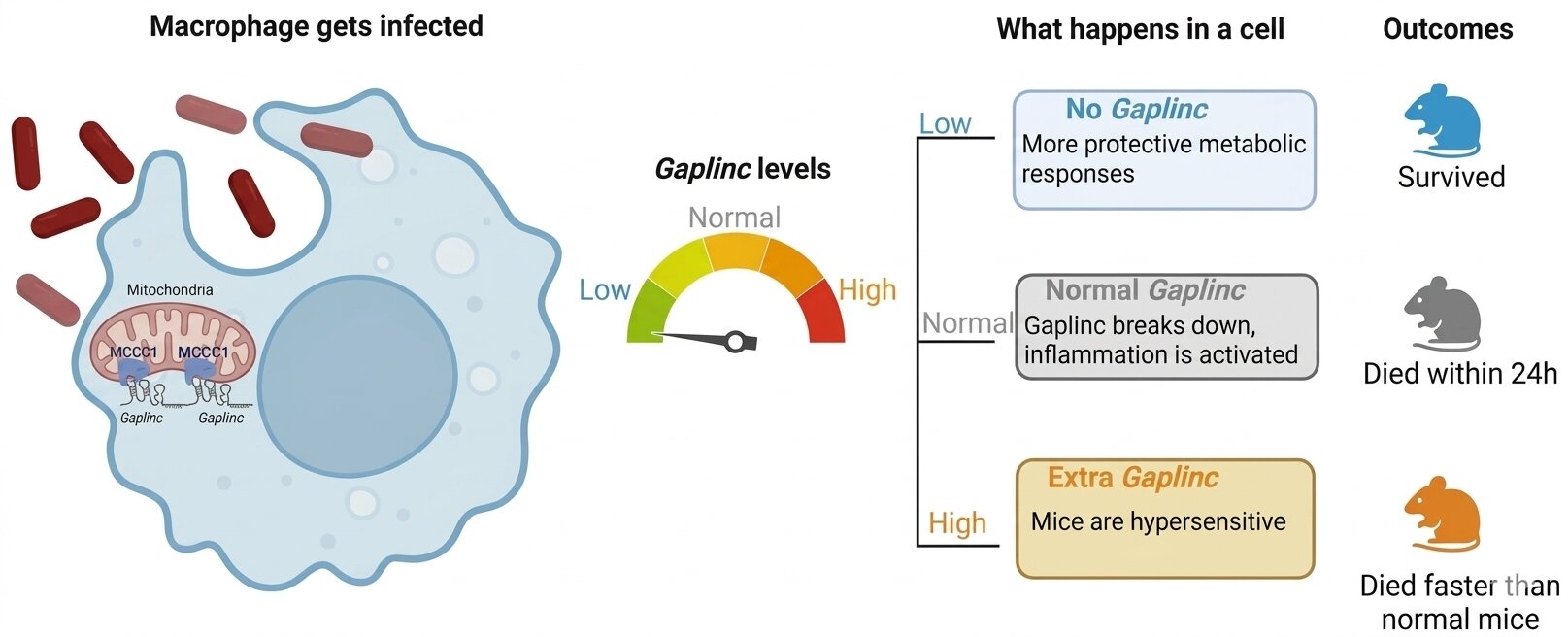
In the paper, researchers at the University of California, Santa Cruz, report that a specific RNA molecule called Gaplinc acts as a genetic "dimmer switch"—or rheostat—that controls both inflammatory activity and cellular metabolism inside immune cells. This discovery presents a promising new strategy for treating sepsis, which kills at least 20% of adults and 10% of children who develop the illness, according to the Centers for Disease Control and Prevention (CDC).
Sepsis occurs when the immune system overreacts to an infection, triggering runaway inflammation that damages healthy organs. Currently, clinicians have few treatment options beyond fluids, antibiotics and supportive care.
The new study reveals that Gaplinc, a long noncoding RNA (lncRNA) found in key immune cells known as macrophages, directly regulates host survival during endotoxic shock.
It does this by binding to an enzyme called MCCC1 inside the cell's energy factories, the mitochondria. By attaching to MCCC1, Gaplinc bridges gene expression with metabolic processing. In mouse models where Gaplinc was completely absent, baseline immune genes remained slightly "pre-armed," and circulating blood fats shifted into a protective, "sepsis-resistant" balance.
This boosts helpful lipids called lysophosphatidylcholines while reducing toxic free fatty acids.
Source link





