The rollout builds directly on GE HealthCare’s acquisition of Caption Health in 2023, expanding an integrated cardiopulmonary AI stack that already includes Caption AI for real-time cardiac probe guidance and Caption Interpretation Auto EF for automated ejection fraction calculation.
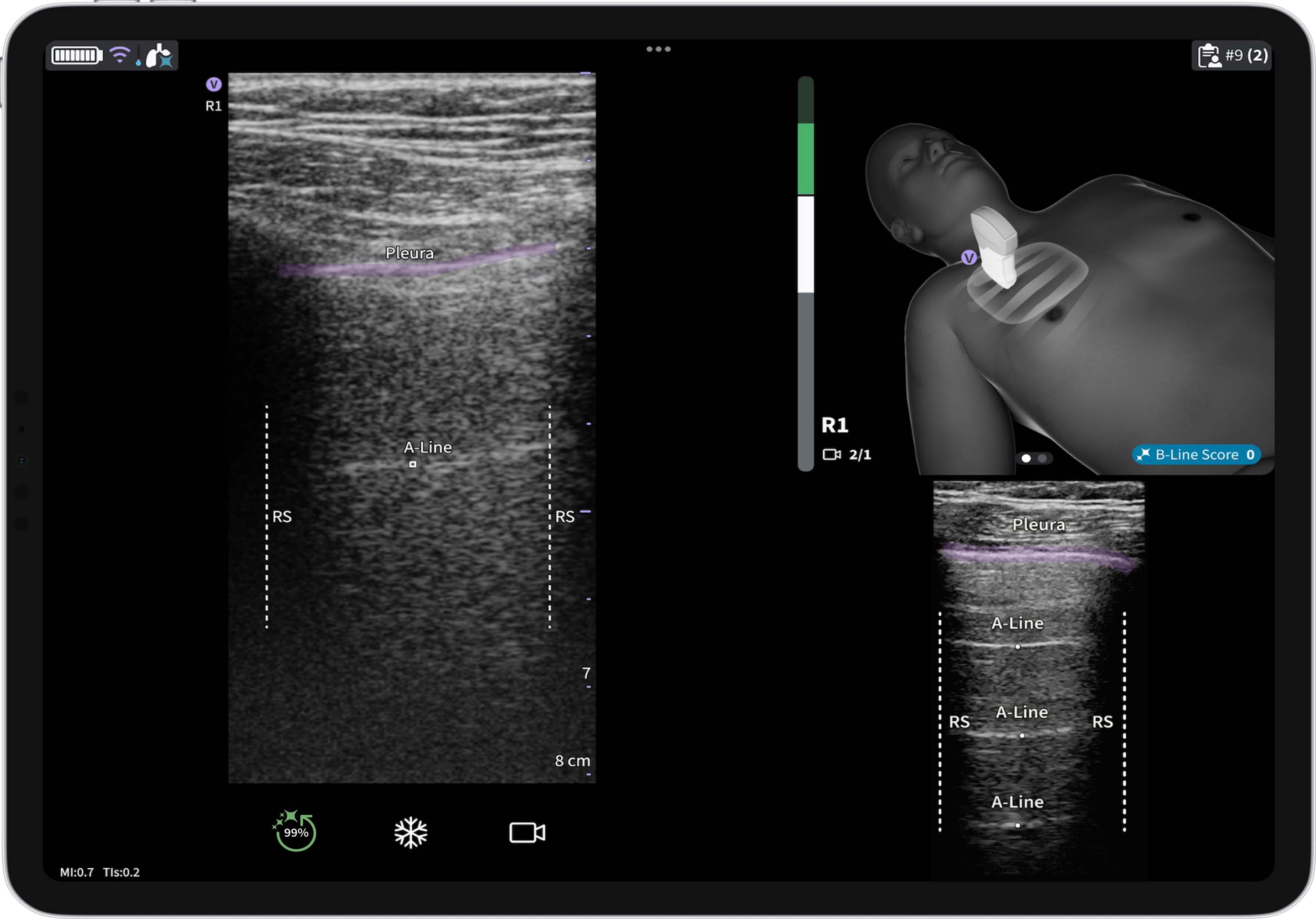
Operating across the standard clinical eight-zone lung examination protocol, Lung Guidance assists non-expert clinicians through real-time probe optimization. The vision algorithm continuously identifies critical sonographic landmarks, including the sliding pleural line, horizontal A-lines, rib acoustic shadows, the diaphragm, and abdominal boundary interfaces. The system triggers automatic clip recording the moment image-quality and landmark thresholds are satisfied, while a dedicated save feature buffers frames during challenging acoustic sweeps. In addition to automated identification and standardized scoring of vertical B-lines to monitor heart failure congestion, validation testing showed that Lung Guidance enabled non-expert sonographers to successfully complete diagnostic-quality lung examinations with a 95.2% success rate, operating at near parity with expert sonographers at 96.8%.
Complementing pulmonary assessment, AutoAS targets aortic stenosis, which often progresses silently and is notoriously difficult to diagnose through bedside auscultation in elderly or bariatric cohorts. Using the phased-array transducer of the Vscan Air SL, AutoAS requires at least two standard cardiac acoustic views—such as parasternal long-axis, parasternal short-axis at the aortic valve, or apical five-chamber. The software analyzes valve leaflet calcification, mobility, and spatial orifice dynamics to generate a binary visual estimation indicating whether image patterns suggest moderate-to-severe aortic stenosis, paired with an algorithmic confidence metric. Validated against a consensus panel of expert echocardiographers, the model reduces diagnostic variability and missed valvular disease compared to unassisted visual estimation by non-cardiologists.
Source link