
This article has been reviewed according to Science X's editorial process and policies. Editors have highlighted the following attributes while ensuring the content's credibility:
The first time Bilal Haider saw the recordings, he thought something had gone wrong. Haider has spent his career studying vision, trying to understand how the brain transforms light hitting the retina into the rich visual world we experience: a face, a tree, an object moving across a room.
So when his colleague Anthony Lien, a research scientist at Georgia Tech, brought him the results of an experiment, Haider thought he knew what he was looking at. "He showed me these beautiful visual responses," Haider said. "If I hadn't known any better, I would have said, 'Oh, you recorded in the visual cortex.'"
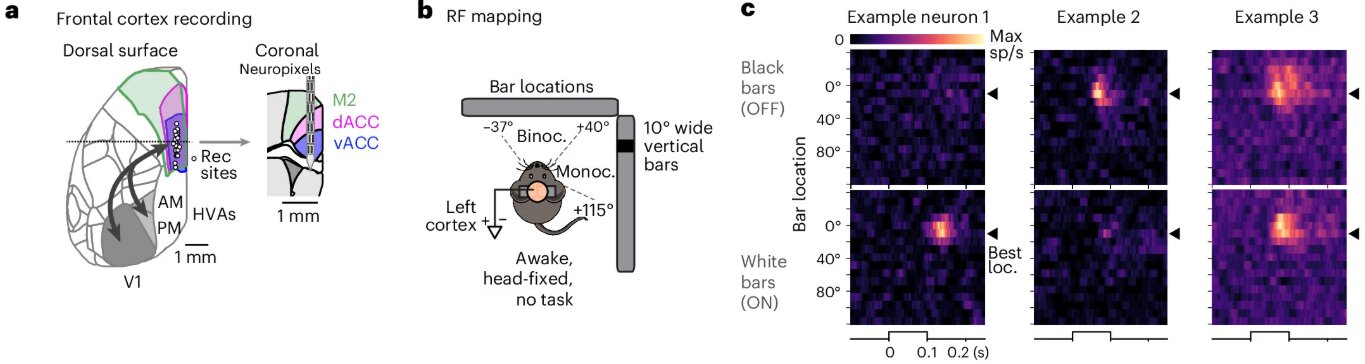
Except Lien wasn't recording from an area dedicated to vision. These signals came from frontal regions associated with movement, attention and decision-making. "This is too weird to be repeatable," Haider remembered thinking. So they tried again. And again.
The researchers found remarkably detailed visual information in frontal areas associated with movement, attention and decision-making. Those unexpected results became the basis of a new Nature Neuroscience study led by Lien and Haider, an associate professor and Gellerstedt Term Professor in the Wallace H. Coulter Department of Biomedical Engineering at Georgia Tech and Emory University.
Finding these "eyes" in the brain's movement and cognition areas complicates the neat divisions we often draw between seeing, thinking and acting. It could also offer new insight into how biological neural networks preserve and route information, with potential lessons for AI.
Source link





