
This article has been reviewed according to Science X's editorial process and policies. Editors have highlighted the following attributes while ensuring the content's credibility:
Athletes and physically active individuals often exercise in hot environments, which can dangerously increase body temperature and cardiovascular strain. Water immersion is a commonly used strategy to cool the body after exercise because water transfers heat more efficiently than air. However, how quickly the body cools down may depend on the type of exercise performed before cooling begins.
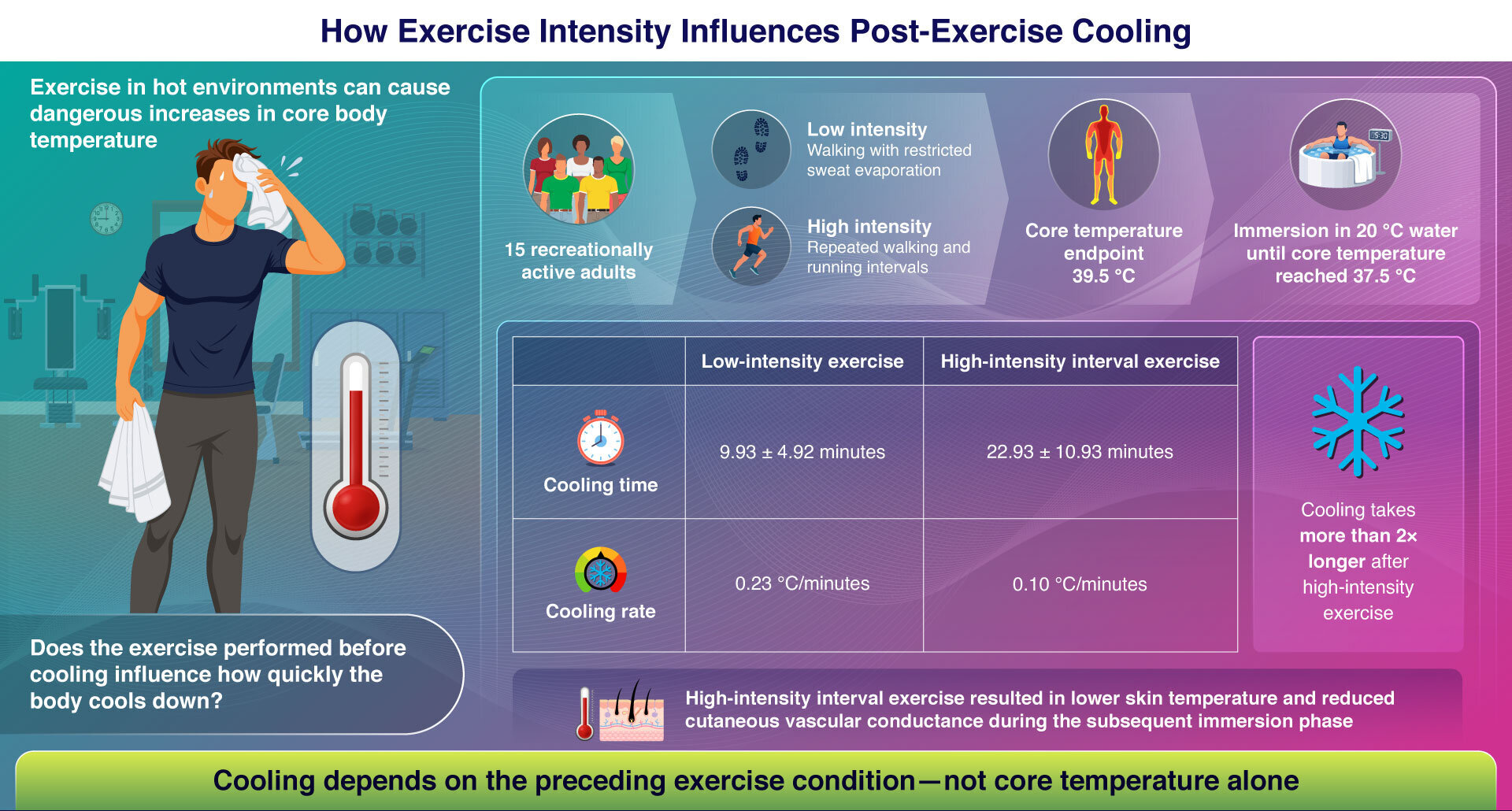
To investigate the effect of exercise, a team of researchers led by associate professor Chansol Hurr at Jeonbuk National University in South Korea studied the postexercise cooling rate in 15 recreationally active adults during two exercise trials in a hot environment: low-intensity exercise with restricted evaporative heat loss and high-intensity interval exercise. The findings were made available online on Aug. 20, 2026, and published in the Journal of Thermal Biology.
For low-intensity exercise, the participants walked on a treadmill while wearing a nonpermeable poncho to restrict sweat evaporation and heat loss. For high-intensity interval exercise, participants alternated between three minutes of walking and two minutes of running on a treadmill in a hot environment. Both trials continued until core temperature reached 39.5°C (103.1 degrees Fahrenheit) or participants stopped because of fatigue. Participants were then immersed in 20°C (68 degrees Fahrenheit) water until their core temperature declined to 37.5°C (99.5 degrees Fahrenheit).
The results revealed a striking difference between the trials. Cooling took an average of approximately 10 minutes after low-intensity exercise compared with around 23 minutes after high-intensity interval exercise.
Source link





