
This article has been reviewed according to Science X's editorial process and policies. Editors have highlighted the following attributes while ensuring the content's credibility:
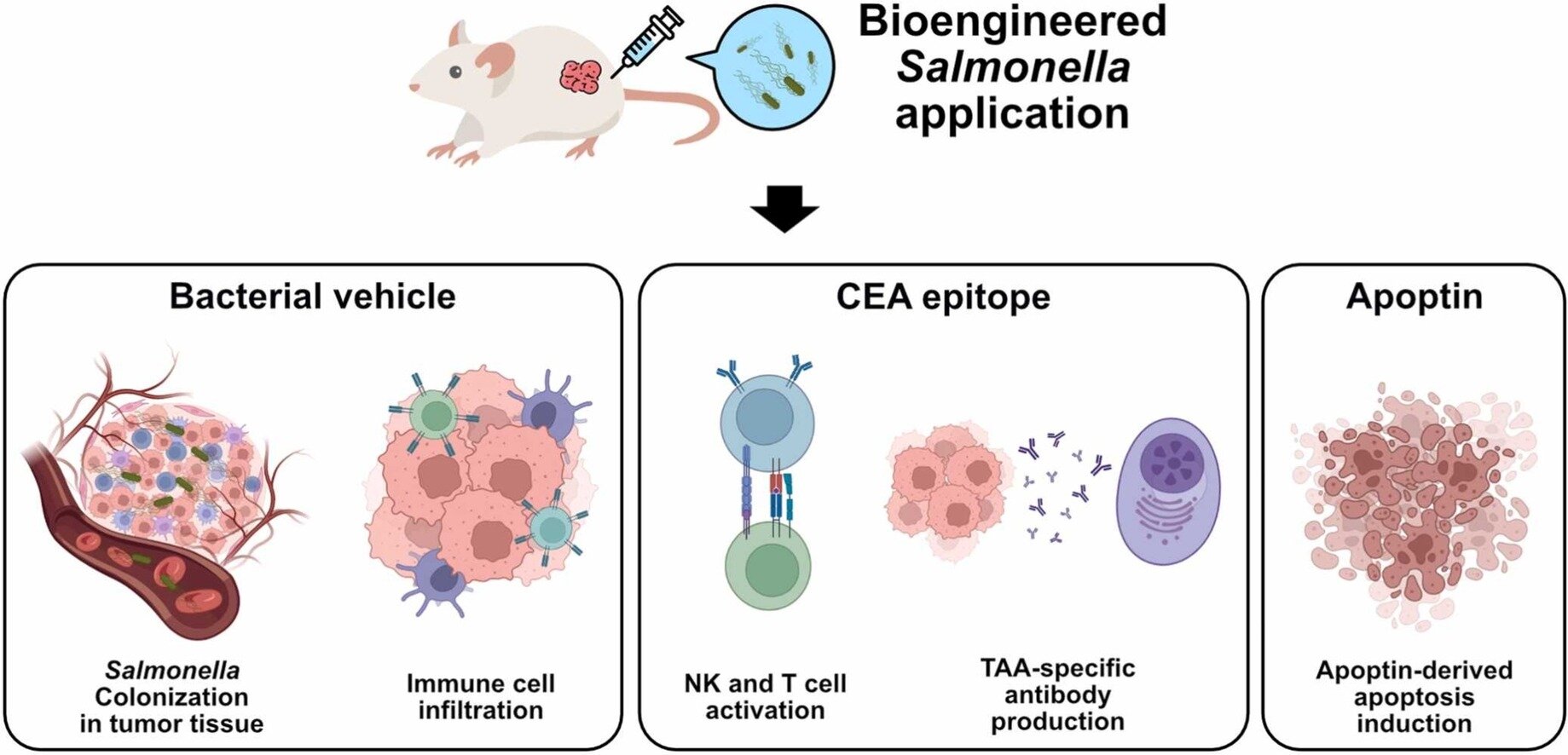
Tumors that resist immune attack, recur and spread pose a major challenge to cancer treatment. Because certain bacteria naturally accumulate within tumors, they serve as potential carriers for anticancer agents. Addressing this, a research team from the Republic of Korea—led by professor John Hwa Lee from the Laboratory of Veterinary Public Health, College of Veterinary Medicine, Jeonbuk National University—developed an engineered strain of Salmonella Typhimurium carrying two anticancer components.
The team deleted the trpA, trpE, asd and pagL genes to attenuate the bacterium and make it dependent on tryptophan, then passaged it in tumor-bearing mice to improve tumor localization. The resulting strain, JOL3136, carried a dual-expression plasmid designed to produce apoptin inside cancer cells and a carcinoembryonic antigen (CEA) epitope protein in the bacterial compartment. The team confirmed apoptin expression at 18 kDa and CEA epitope expression at 27 kDa.
This paper was published in the journal Biomedicine & Pharmacotherapy on Sept. 1, 2026.
The team tested the engineered bacteria using 4T1 cells, a highly metastatic mouse breast cancer cell line. Compared with untreated cells and bacterial-vector controls, JOL3136-treated cells showed greater early and late apoptosis. Mice bearing 4T1 tumors received four weekly doses of a control solution, the bacterial vector or JOL3136. The therapeutic strain significantly reduced tumor mass and volume compared with both control groups. Tumor-volume reduction in the JOL3136 group was reported to exceed that of the vector-control group by more than 200%.
Source link





