This article has been reviewed according to Science X's editorial process and policies. Editors have highlighted the following attributes while ensuring the content's credibility:
Close your eyes and cover your ears. Much of the world around you disappears from view and hearing, yet your sense of being present, of being conscious, remains. What creates that basic feeling of being "you"?
A hypothesis paper published in The Neuroscientist by Professor Marshall Devor of the Hebrew University of Jerusalem and Dr. Mark Baron of the Hebrew University and Harvard Medical School proposes that the answer lies deep in the brainstem.
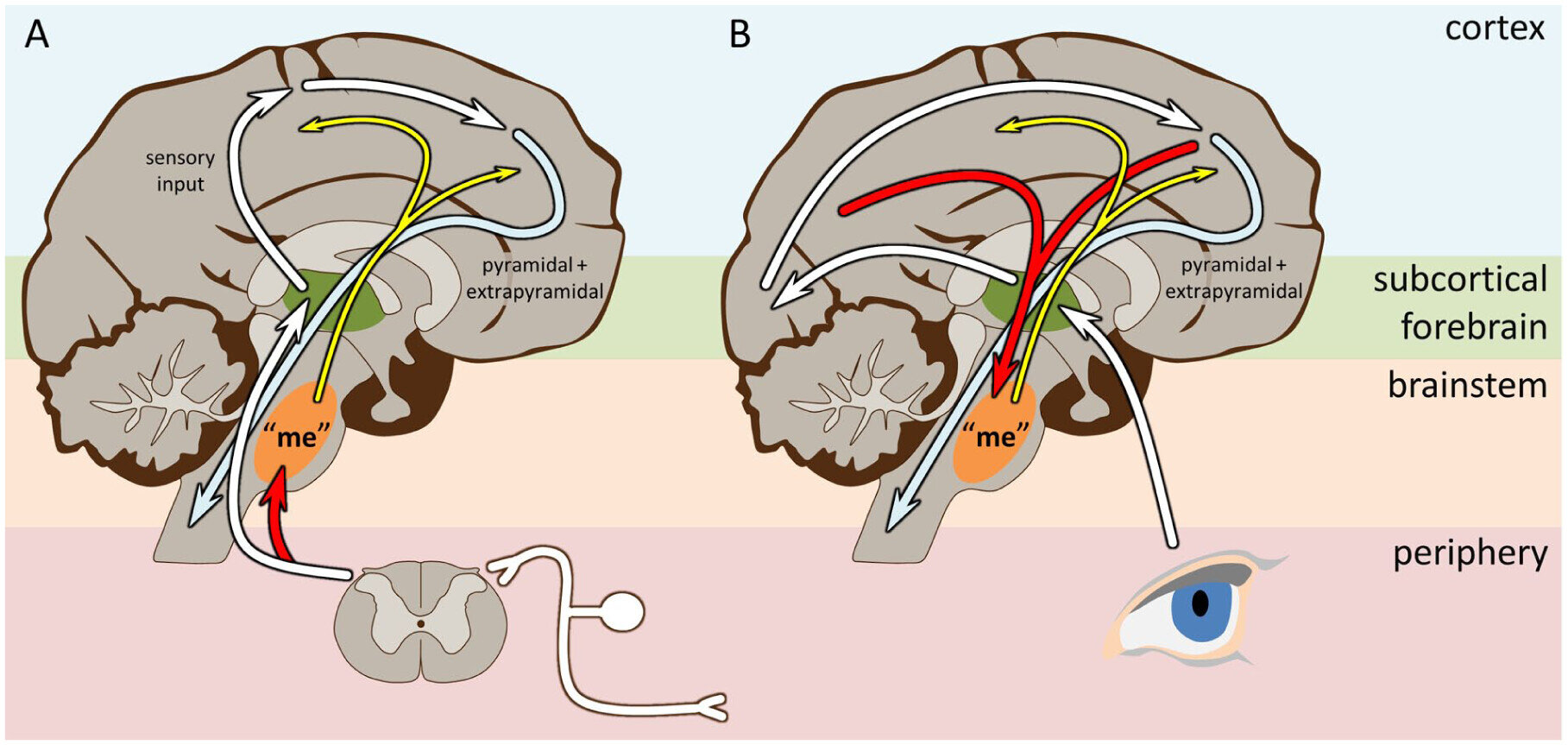
Their argument challenges approaches that place the source of conscious experience primarily in the cerebral cortex—the brain's folded outer layer, responsible for complex functions including language, recognition and planning. Instead, they suggest that the basic capacity to feel and experience originates in older "primitive" brainstem circuitry.
The paper brings together existing experimental findings and clinical observations to develop this theory. It does not claim to establish a proven mechanism for consciousness.
Detecting a harmful stimulus and feeling pain are different things. The nervous system can trigger an automatic "reflexive" withdrawal from danger, but pain also involves a subjective experience: it hurts.
Devor and Baron argue that evidence from brain stimulation, epileptic seizures, neurological injuries and other research suggests that this feeling does not depend on the cortex in the same way that complex visual or auditory experiences do.
For example, they point out that even extensive cortical damage usually leaves pain experience intact, or even increased, while such damage can severely degrade vision and hearing.
Source link