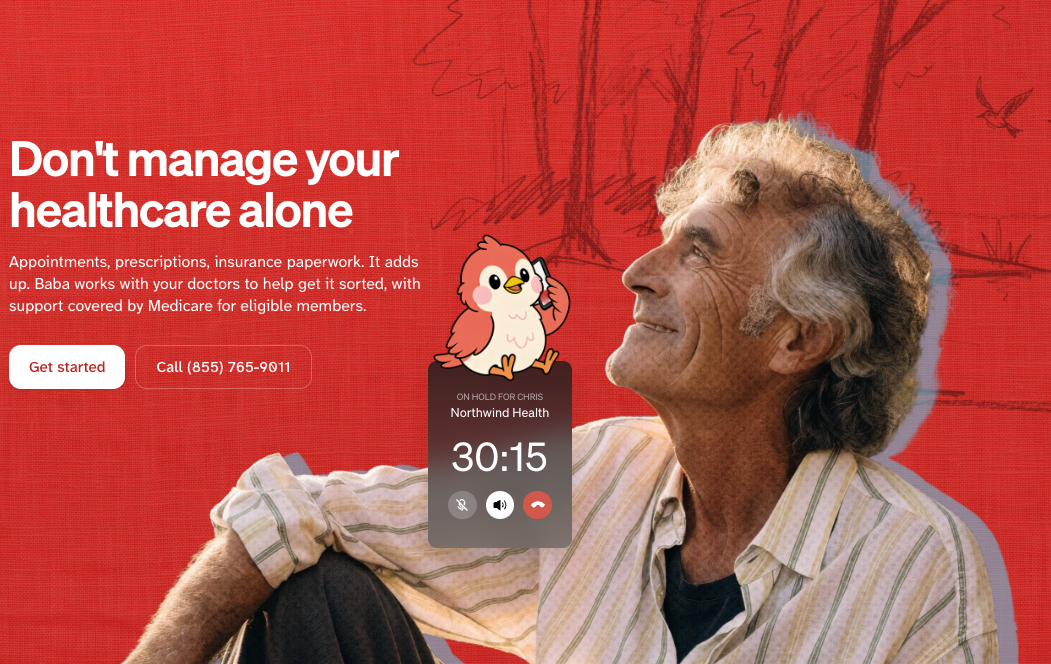
Historically, personalized patient advocacy has been an elite concierge product, accessible only to affluent families capable of paying out-of-pocket for private geriatric care managers. Traditional Medicare fee-for-service payment rails provide virtually no dependable margin for high-touch navigation, driving up the cost of managing complex, multimorbid patients to unsustainable levels.
Baba’s thesis centers on leveraging applied artificial intelligence to compress the administrative overhead of care coordination, making continuous longitudinal advocacy economically viable across publicly insured populations.
Under Baba’s hybrid care delivery model, every enrolled patient is paired with a dedicated human care team that includes care coordinators and licensed clinical social workers or therapists. The human staff is backed by proprietary AI agents that manage the logistical heavy lifting: synchronizing specialist referrals, tracking hospital-to-home discharge transitions, coordinating in-home aide support, troubleshooting billing denials, and securing community resources such as housing assistance and medical transportation.
To date, Baba has supported more than 10,000 patients and families nationwide, with more than 100,000 families currently on its waitlist, reflecting massive latent demand for patient-facing logistical navigation.
Alongside its clinical operations, Baba is carving out a technical niche within applied AI research with the release of BabaBench, a benchmark specifically designed to evaluate how frontier foundation models and autonomous agents execute complex, long-horizon healthcare tasks.
Most standard AI evaluations test conversational fluency, factual retrieval, or isolated clinical board exam questions. In contrast, BabaBench evaluates whether an agent can autonomously complete an end-to-end bureaucratic workflow across weeks or months—such as disputing an erroneous balance bill, parsing insurer coverage criteria, or completing multi-page social program applications—without generating prohibited clinical actions or triggering protected health information (PHI) privacy violations.
Source link