
This article has been reviewed according to Science X's editorial process and policies. Editors have highlighted the following attributes while ensuring the content's credibility:
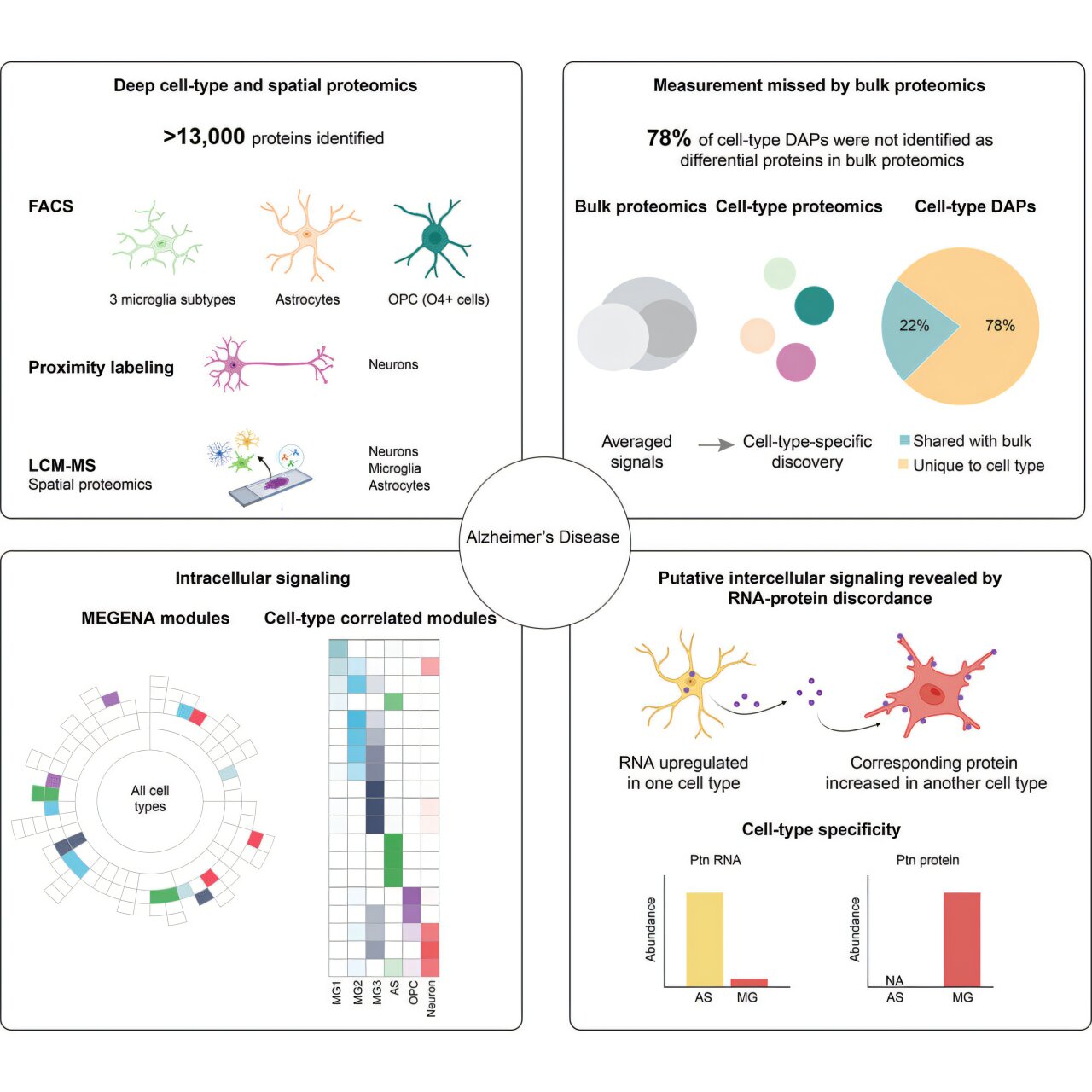
Alzheimer's disease can affect almost the entire brain, but how different cell types are specifically affected is not fully understood. To address this gap, St. Jude Children's Research Hospital scientists developed a cell type–specific protein atlas using brains from mouse models of Alzheimer's disease. By combining and comparing multiple types of data, they identified more than 3,000 proteins with altered levels across a range of cell types, 78% of which had not been captured before.
A focused look at microglia, which express many Alzheimer's disease risk genes, revealed that almost all the changes to this cell type were previously undetected. The approach also uncovered a potential intercellular communication network, where proteins made in one cell type are secreted and function in another cell type. The findings, published in Neuron, provide much-needed cell type–specific context to the pathology of Alzheimer's disease.
Single-cell RNA sequencing has revolutionized Alzheimer's disease research, but it provides only a partial view of cellular activity. Proteomic profiling fills many gaps, but has largely been limited to bulk analysis, resulting in lost context. Now, by combining next-generation mass spectrometry methods with single-cell RNA sequencing and spatial omics, co-corresponding authors Junmin Peng, Ph.D., Departments of Structural Biology and Developmental Neurobiology, and Jiyang Yu, Ph.D., Department of Computational Biology interim chair, obtained the needed cell type–specific information.
"This is the first cell-type-resolved proteomic analysis we are aware of in the Alzheimer's disease field.
Source link





