This article has been reviewed according to Science X's editorial process and policies. Editors have highlighted the following attributes while ensuring the content's credibility:
Mayo Clinic researchers have found that an artificial intelligence (AI) tool may provide dermatologists with additional information to help assess whether skin lesions are cancerous and inform their clinical decisions about whether to biopsy or monitor them, according to a study published in Mayo Clinic Proceedings.
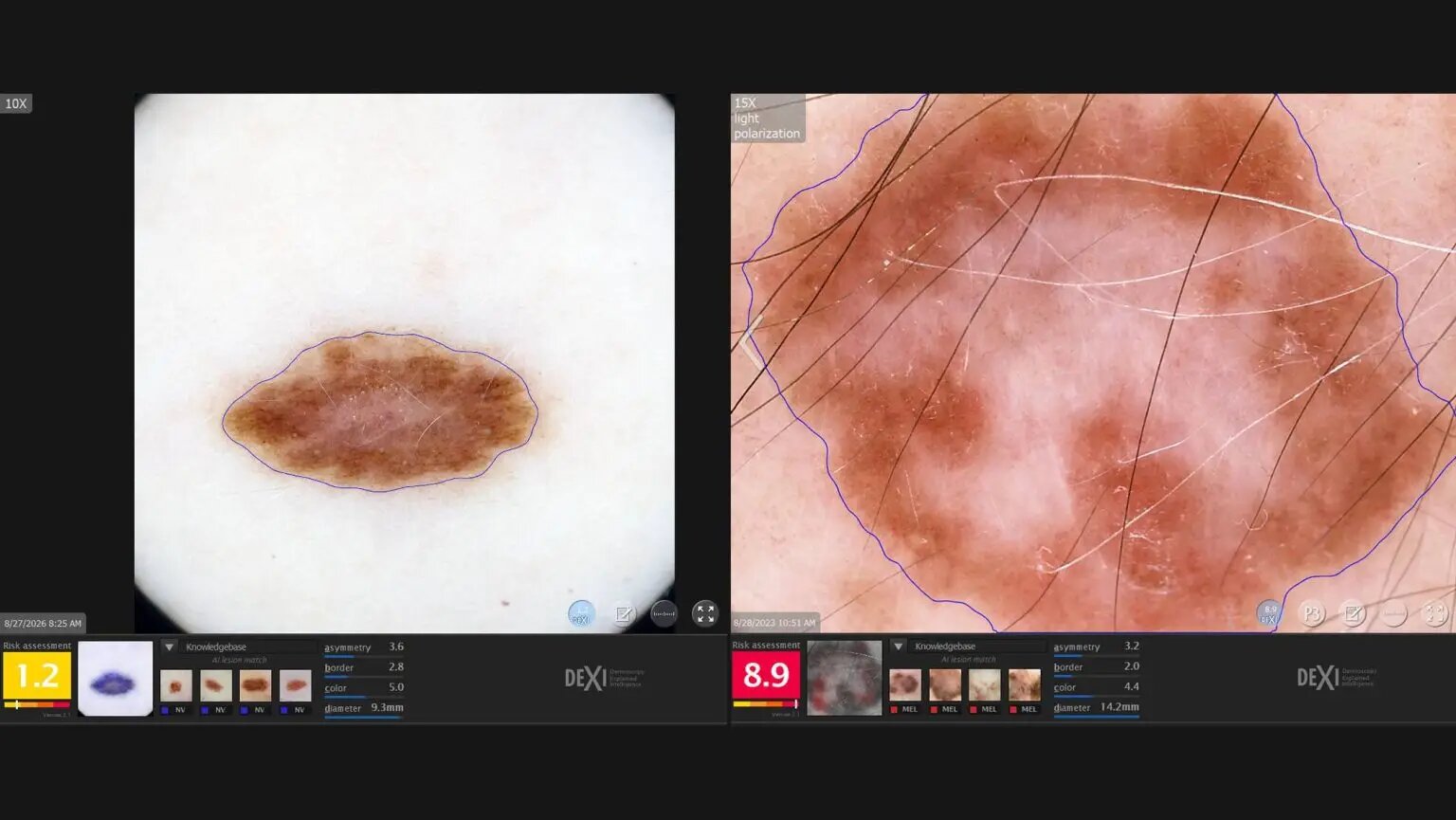
The tool, called Dermoscopy Explainable Intelligence (DEXI), is part of an advanced imaging system that dermatologists use to capture and track skin lesions over time. DEXI assigns lesions a score from 0.0 to 10.0 based on image characteristics associated with cancer risk. It also identifies features—such as asymmetry, border and color—that contribute to the score, providing dermatologists with additional information they can consider alongside their clinical evaluation.
Researchers evaluated DEXI scores for skin lesions with known diagnoses. Using a threshold of 3.0—meaning a score of 3.0 or higher was considered positive for potential skin cancer—DEXI correctly identified 93.4% of cancerous lesions and 75% of noncancerous lesions.
"Prior to the study, I would review a patient's DEXI score, but I wouldn't know exactly what to do with the number," says Jenny Link, M.D., a dermatologist at Mayo Clinic and the study's lead author. "Now I can confidently use the score as another piece of data to inform my clinical judgment on whether I recommend a biopsy or monitoring."
DEXI is a deep-learning tool trained on more than 66,000 annotated dermoscopy images.
Source link