
This article has been reviewed according to Science X's editorial process and policies. Editors have highlighted the following attributes while ensuring the content's credibility:
As drug-related crime rises rapidly worldwide, the need for fast, reliable technologies that can identify illicit drug use at the point of testing is becoming increasingly urgent. Laboratory testing can provide accurate results, but it requires multiple sample preparation steps and specialized analytical equipment. In contrast, rapid on-site test kits offer faster results, yet their accuracy is limited by factors such as insufficient volume and cross-reactivity with structurally similar drugs.
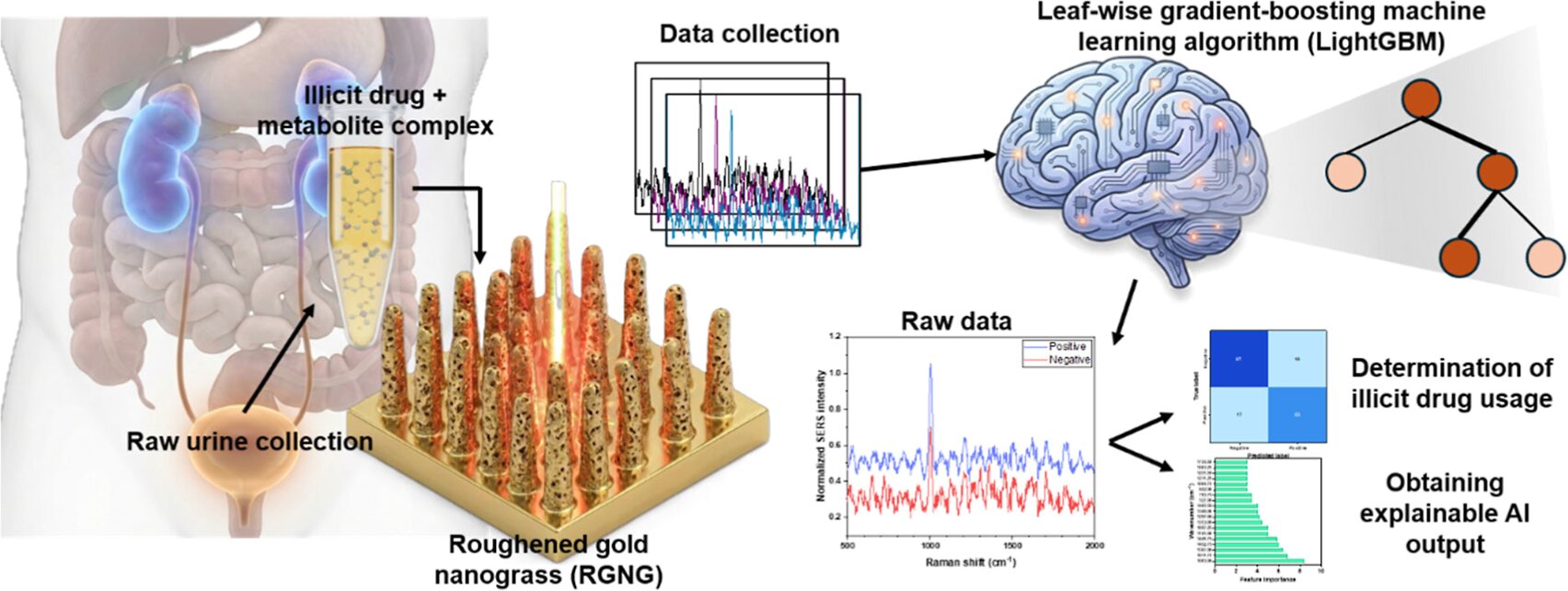
A research team led by Dr. Eun-Kyung Lim at the Bionanotechnology Research Center of the Korea Research Institute of Bioscience and Biotechnology (KRIBB) has developed a platform that combines nanotechnology and artificial intelligence to screen urine for illicit drug use within five minutes, without chemical pretreatment. The study was conducted in collaboration with professor Tae Hwan Kim at Daegu Catholic University, professor Joon Hee Lee at Seoul National University Bundang Hospital and the AI Research Center at StoneLab, and is published in ACS Measurement Science Au.
The researchers developed a nanostructured substrate that amplifies the faint light signals produced by drug molecules millions of times or more. They formed densely packed, grasslike nanopillars on a thin gold surface and roughened their surfaces by selective etching. When drug molecules settle on the substrate, their characteristic vibrational light signals become much stronger, allowing even trace amounts to be clearly identified.
The team also used an artificial intelligence model called LightGBM to distinguish the unique signal fingerprints of illicit drugs from the complex background signals in urine.
Source link





