
This article has been reviewed according to Science X's editorial process and policies. Editors have highlighted the following attributes while ensuring the content's credibility:
Lymphatic malformations are rare disorders in which lymph vessels develop abnormally, often beginning in childhood and sometimes causing swelling, infection, bleeding, pain or airway obstruction.
Researchers led by the University of Osaka have combined genetic analysis with detailed examination of patient tissues to uncover common features of the disease and identify molecular clues that could inform future treatment strategies.
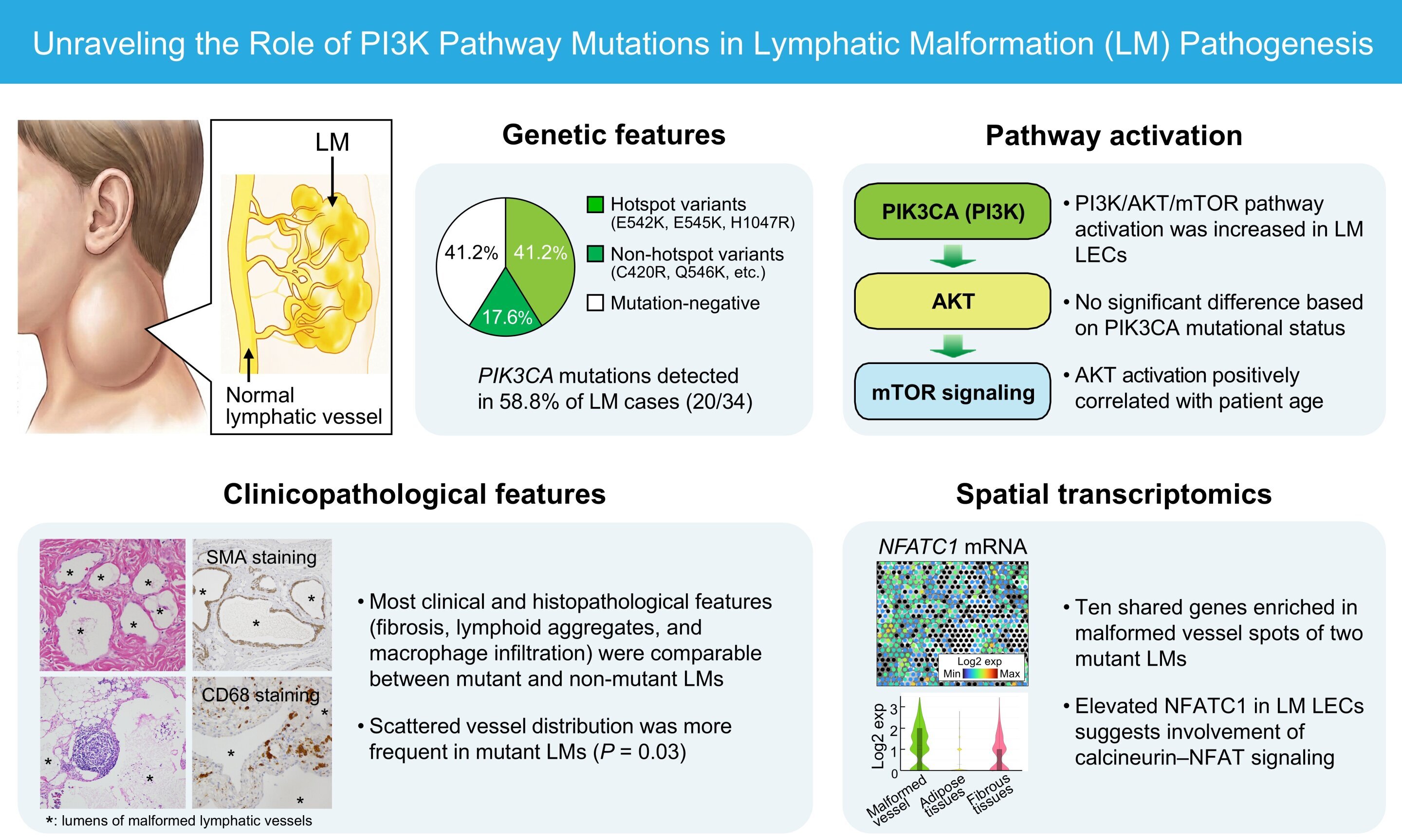
In their work published in the journal Laboratory Investigation, the team analyzed tissue samples from 34 patients. Changes in the PIK3CA gene, which are known to contribute to abnormal lymphatic vessel growth, were detected in 20 patients, or 58.8%. Most clinical features were similar whether or not a mutation was detected, but malformed vessels showed a more scattered growth pattern in patients carrying PIK3CA mutations.
The researchers also found that a major cell-growth signaling system, the PI3K/AKT/mTOR pathway, was more active in malformed lymphatic vessels than in normal vessels regardless of PIK3CA mutation status. AKT activity also increased with patient age. These findings are consistent with the clinical effectiveness of sirolimus, a drug that targets this pathway, across patients with lymphatic malformations.
To search for additional disease-related molecules, the team performed spatial transcriptomic analysis in two PIK3CA-mutant cases. Ten genes were more active in malformed lymphatic vessels in both cases. Among them, NFATC1 was strongly expressed in the endothelial cells lining malformed lymphatic vessels.
The findings suggest that the calcineurin-NFAT pathway may also contribute to disease pathogenesis and could represent a future therapeutic target.
Source link





