
This article has been reviewed according to Science X's editorial process and policies. Editors have highlighted the following attributes while ensuring the content's credibility:
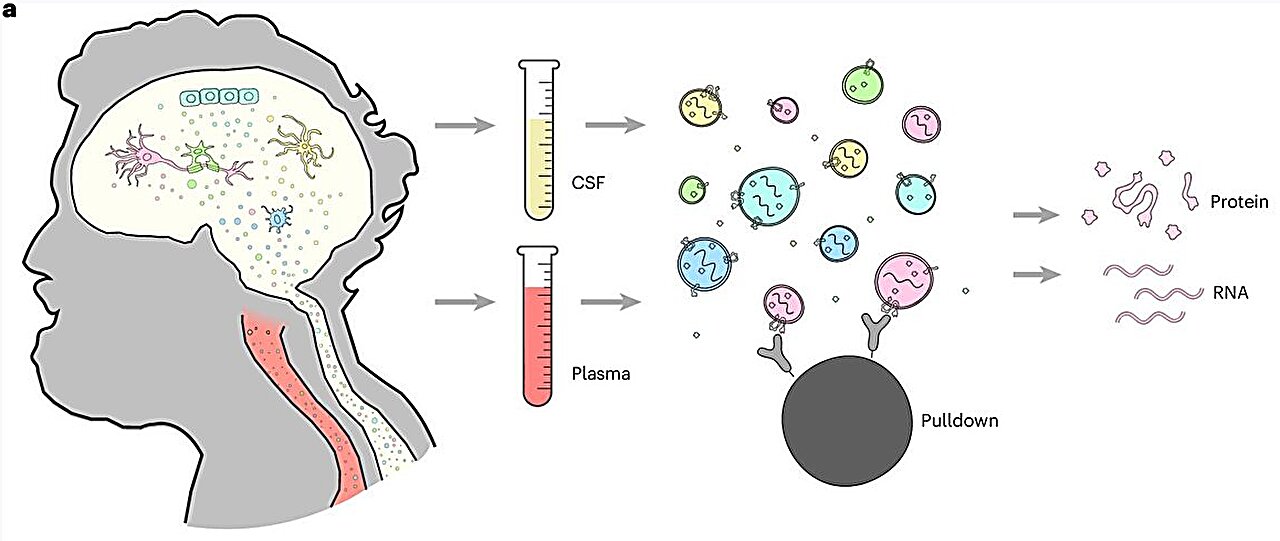
Cells release tiny particles that can carry proteins and RNA from the cells that produced them. These membrane-enclosed packets, known as extracellular vesicles (EVs), are found in blood and other bodily fluids.
EVs could carry clues about cells that are difficult to sample and study directly, such as neurons. However, determining which cells released specific vesicles has so far proved difficult.
Researchers at the Wyss Institute for Biologically Inspired Engineering, the Massachusetts Institute of Technology (MIT) and other institutions recently found a protein strongly associated with neurons on the surface of some EVs in human blood plasma and cerebrospinal fluid.
Their paper, published in Nature Neuroscience, introduces a method to isolate vesicles with this protein.
"This project started by thinking about the fact that the brain is very inaccessible and it would be great to have ways to read out what is happening in the brain at the molecular level over time," Dmitry Ter-Ovanesyan, first author of the paper, told Medical Xpress.
"We wanted to do this by taking a biofluid that we can sample, such as cerebrospinal fluid (CSF) or, ideally, blood. For this purpose, we turned to EVs, which are pieces of membrane released by all cells into surrounding biofluids that contain RNA and protein from their cell of origin."
EVs have proteins attached to their outer surface. Ter-Ovanesyan and his colleagues wanted to determine whether some of these proteins could be used to distinguish and isolate vesicles released by neurons from those released by other cells.
Source link





