
This article has been reviewed according to Science X's editorial process and policies. Editors have highlighted the following attributes while ensuring the content's credibility:
Researchers at UCLA Health have shown in lab-grown human brain cells that boosting the activity of a healthy gene copy can offset the effects of a mutation linked to autism. The findings, published in Nature Neuroscience, suggest a new direction for treating autism and related neurodevelopmental conditions, though the work is still at an early stage.
Autism is highly heritable, and roughly 15% of its genetic risk comes from new mutations that appear for the first time in a child rather than being inherited from a parent. Many of these mutations disable one of the two copies of a gene. Because a single working copy often cannot produce enough of the gene's product on its own, neurodevelopment can be altered.
Most current autism treatments address symptoms resulting from these genetic mutations rather than underlying biology.
The UCLA team, led by Dr. Daniel Geschwind, focused on two genes strongly tied to autism, CHD8 and SCN2A. CHD8 helps regulate other genes involved in brain development, while SCN2A is essential for neurons to fire electrical signals.
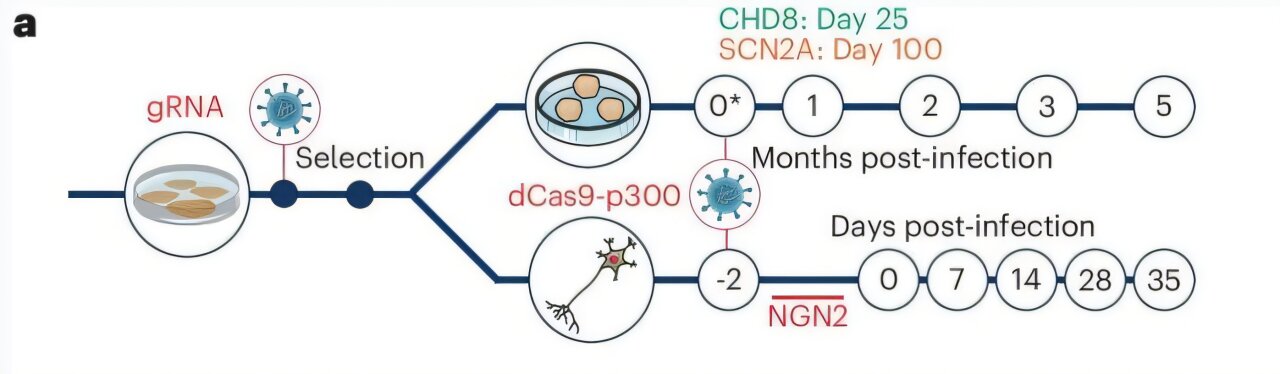
Rather than replacing or editing the faulty gene, the researchers used a modified form of CRISPR to switch up the activity of the remaining healthy copy. They aimed it at enhancers, stretches of DNA that act like dials controlling when and how strongly a gene is expressed, often in a cell type–specific manner.
Source link





