This article has been reviewed according to Science X's editorial process and policies. Editors have highlighted the following attributes while ensuring the content's credibility:
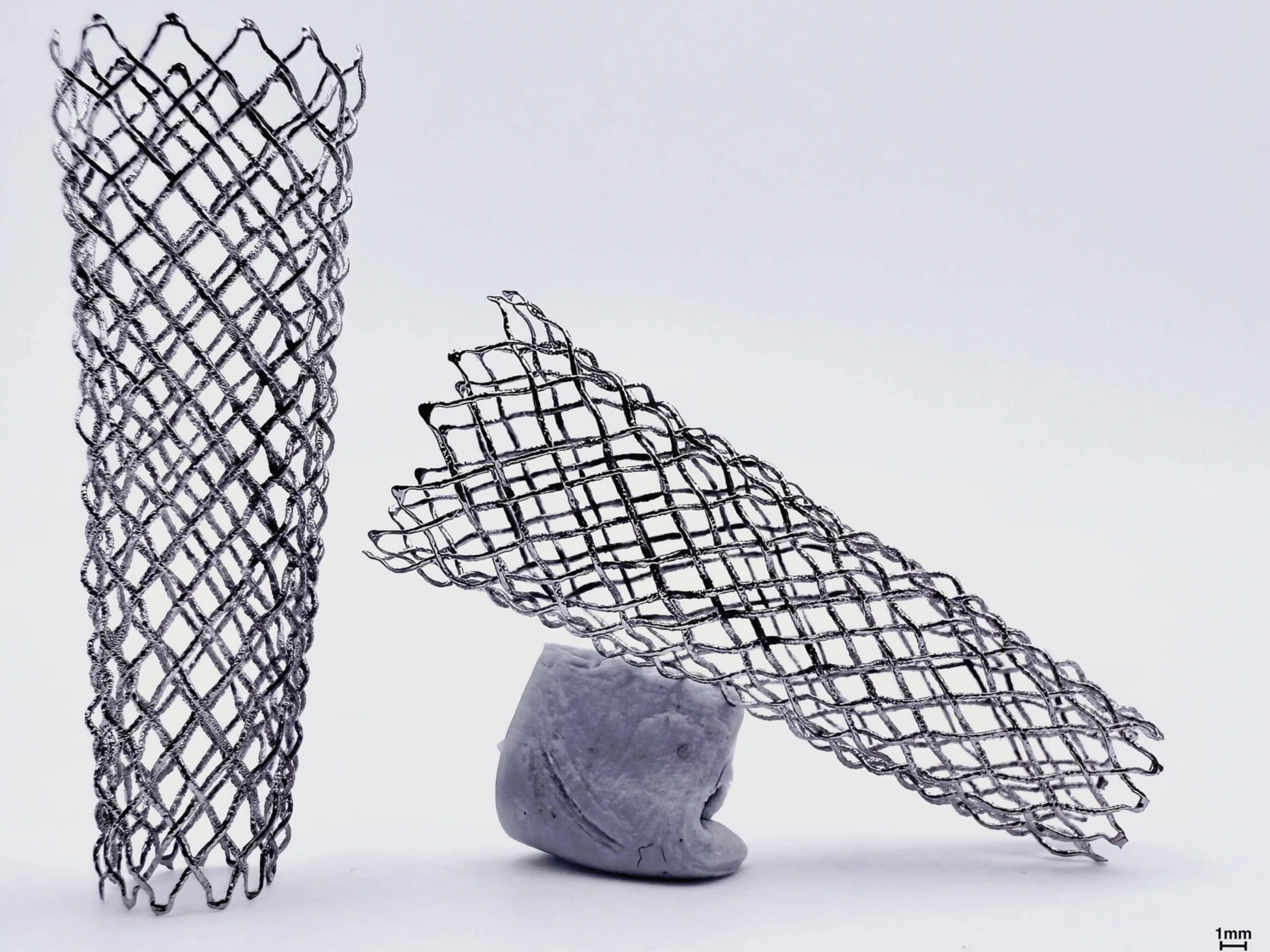
An international research team led by IMDEA Materials Institute and Universidad Politécnica de Madrid (UPM) has developed a method for manufacturing personalized cardiovascular medical devices using three-dimensional printing of nitinol, a superelastic alloy.
This research, published in npj Metamaterials, also involved researchers from the Massachusetts Institute of Technology (MIT) and the University of Galway, and enables the design and manufacture of highly flexible braided structures in a single production step.
The technology has already been patented, and its potential has been recognized with the National James Dyson Award.
These structures mimic blood vessels and can be compressed without failure, enabling their delivery through a catheter.
The research addresses one of the principal challenges in the design and manufacture of minimally invasive transcatheter devices (MITDs): the difficulty of developing implants with complex three-dimensional geometries, tailored to the specific needs of individual patients and capable of being compressed for implantation through a catheter.
"The clinical impact of nitinol-based MITDs has been transformative for cardiovascular interventions," explained Dr. Carlos Aguilar Vega, one of the authors of the publication.
"However, despite their widespread clinical adoption, current manufacturing methods impose fundamental geometric limitations that restrict their optimization and personalization.
"While recent advances in powder metallurgy-based techniques, such as spark plasma sintering, have expanded the manufacturing possibilities for these devices, it remains challenging to develop implants that combine complex geometries, mechanical flexibility and patient-specific anatomical adaptation," he added.
Source link