OpenXR is an open, royalty-free standard which provides a single, unified interface for developing VR and AR applications. Most XR platforms support it—excluding Apple, which uses its own APIs for Vision Pro. While that hasn’t changed, OpenXR seems to have taken a page out of Apple’s playbook with a new multitasking spatial app framework.
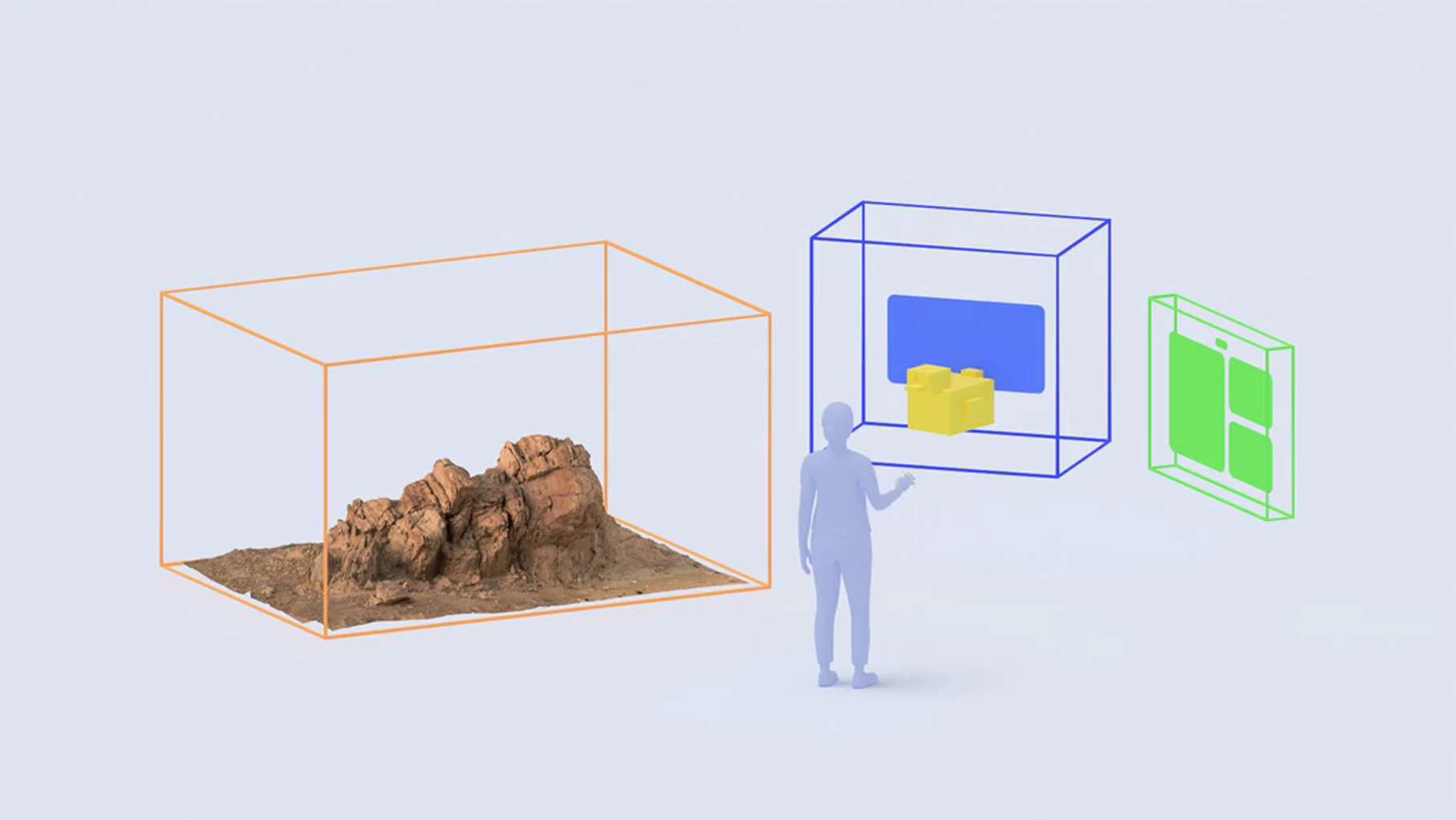
The Khronos Group, which leads development on OpenXR, announced it’s set to roll out a set of extensions soon that include new “spatial containers.” Spatial containers are system-managed spaces where apps can display XR content, similar to how traditional apps draw 2D content within windows on a desktop.
As seen in the short clip below, this will essentially allow for apps to switch between a “bounded” mode for multitasking and an “immersive” mode that takes up the full screen, The Khronos Group says.
It’s admittedly very similar to how visionOS handles multitasking via its Shared Space function, which is basically a spatial desktop that allows multiple 3D applications to live side-by-side and be moved around by the user. Apple Vision Pro has had this feature since launch in 2024.
This comes in contrast to how multitasking works on Quest today, wherein only one spatial app can run at a time, albeit alongside system-level stuff, such as the dashboard, browser, and other multitasked 2D windows.
The Khronos Group says the new extensions have been ratified and published, with implementations expected to begin rolling out across the OpenXR ecosystem during 2026.
Granted, its release doesn’t mean all existing headsets will immediately support it, although it’s a good bet we’ll begin seeing implementations soon from the cadre of OpenXR-supported headsets, which thus far include Meta Quest, SteamVR-compatible PC VR headsets and Steam Frame, Android XR-based headsets, Varjo, Magic Leap, and XREAL glasses.
Source link