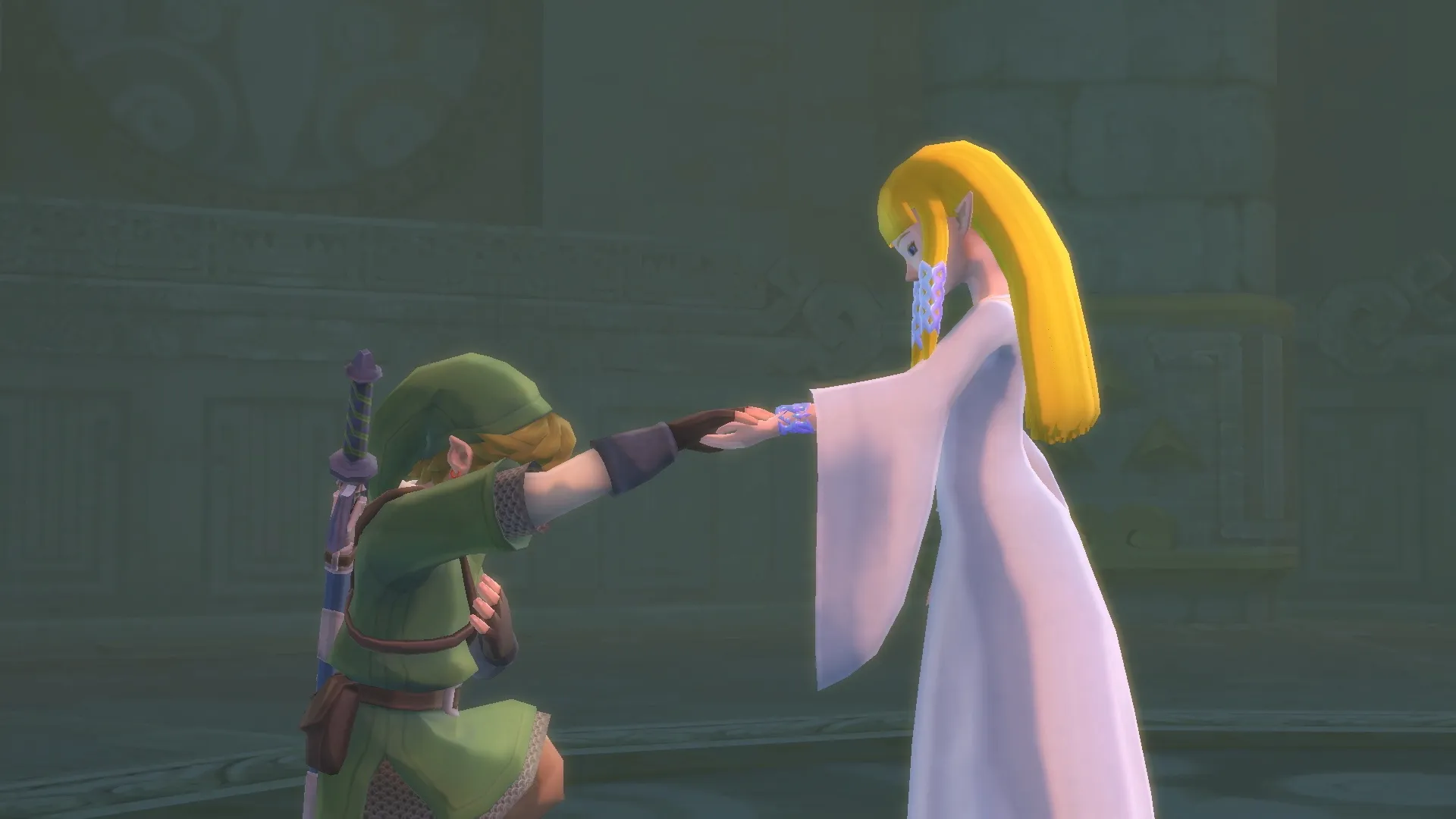
Hold the controller over your head. The Master Sword glows. Point it at the screen, hit Y to recenter, and swing. On the screen, Link swings… kind of the right way. Then, your chatty companion, Fi, chimes in with a very long and earnest explanation of something you figured out several minutes ago. Rinse and repeat for about 40 hours, and that’s Skyward Sword, one of the most cinematic, heartrending, memorable stories Zelda has ever told — and the one saddled with the most finicky gameplay.
All the hallmarks of memorable storytelling are here. You meet and befriend a pompadoured bully who turns into a lovable ally. You can sneak a peek at a princess preserved in amber and wonder about the logistics of time-loop mechanics. You watch Link sigh and steel himself as he descends into dungeons, you feel Zelda’s heart break as she turns away from Link to follow her mentor Impa, you gasp when you figure out the true identity of the villainous Ghirahim. And, unfortunately, you also have to wrestle with the motion controls. If you’re playing it on the Switch, that is. At least you’re not wrangling the Wiimote. And if you are, my apologies.
The Legend of Zelda: Skyward Sword , directed by Hidemaro Fujibayashi and produced by Eiji Aonuma, shipped for the Wii in November 2011. The Switch remaster, Skyward Sword HD , dropped 10 years later. The remaster helped fix some of the less-than-popular gameplay elements with autosave, a player-controlled camera, skippable cutscenes, and the ability to trade the motion controls for a button-only playing experience.
Source link