

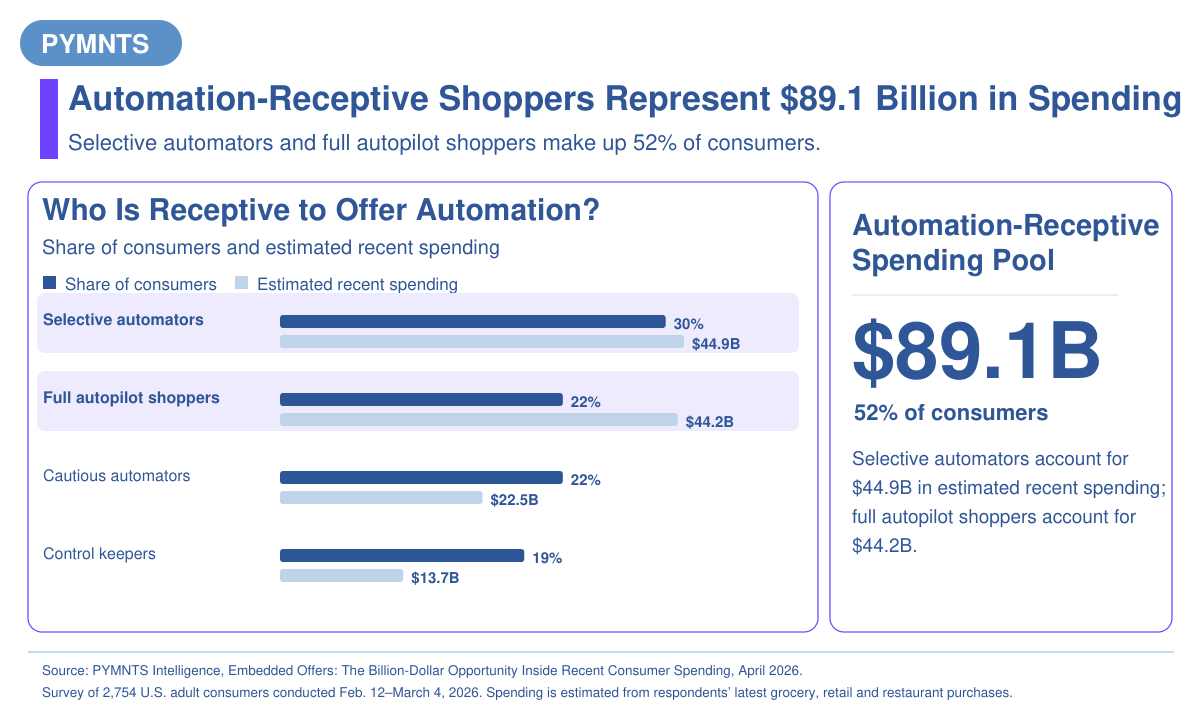
Embedded offers have a sizable audience before merchants, banks and brands solve for full automation. Consumers who are most receptive to automated offer management account for $89.1 billion in estimated recent spending across grocery, retail and restaurant purchases.
The finding comes from “Embedded Offers: The Billion-Dollar Opportunity Inside Recent Consumer Spending,” a PYMNTS Intelligence report produced in collaboration with FIS. The survey of 2,754 U.S. adult consumers examines how shoppers discover and redeem offers and how much control they would give an automated system. Across respondents’ most recent purchases, the report estimates $125.4 billion in spending, with $42.4 billion, or 34%, linked to missed or unredeemed offers.
Three findings show where embedded offers could change the shopping and payment experience:
Automation-receptive consumers represent the largest spending pool. Selective automators and full autopilot shoppers make up 52% of consumers and account for $89.1 billion in combined estimated recent spending. Selective automators represent 30% of consumers and $44.9 billion in spending; they are comfortable with bounded automation such as applying the best payment method or adjusting quantities.
Full autopilot shoppers represent 22% of consumers and $44.2 billion in spending and are willing to let a system optimize payment, quantity and brand.
Offers can change more than price. Across grocery, retail and restaurant purchases, 72% of consumers changed which product they chose after seeing an offer, 71% changed how much they bought and 43% changed their payment method. Zero-effort shoppers lead payment switching at 47%, indicating that a visible, easy-to-use reward can affect which payment method reaches the transaction.
Source link





