Banks have an opportunity to strengthen fraud protection by helping customers recognize when someone is persuading them to send money to a criminal.
Complete the form to unlock this article and enjoy unlimited free access to all PYMNTS content — no additional logins required.
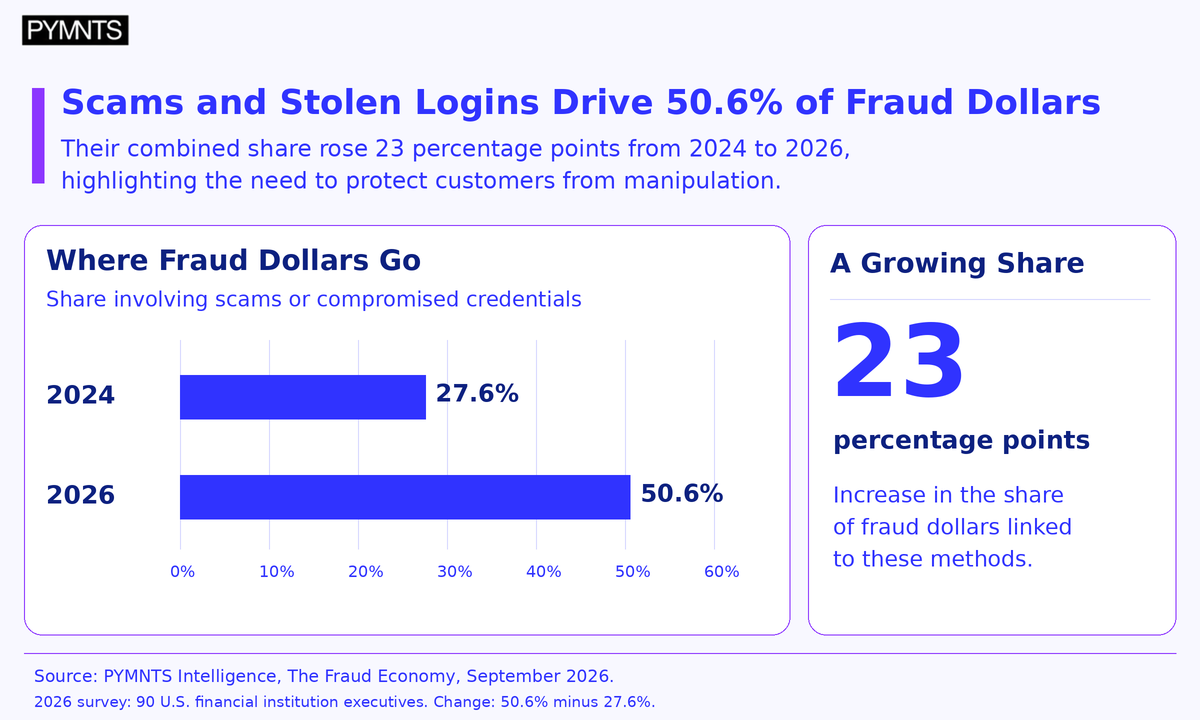
That’s a central finding of “Scams Get Personal: Why Banks Pay More to Fight Fraud,” the September 2026 edition of PYMNTS Intelligence’s “The Fraud Economy.” Based on a July survey of 90 executives at U.S. banks, credit unions and FinTechs, the report finds widespread adoption of detection tools hasn’t stopped fraud involving stolen credentials or manipulated customers. Together, those methods accounted for 50.6% of fraud dollars in 2026, up from 27.6% in 2024. The 23-percentage-point increase points to an opportunity to pair technology with clearer customer guidance. A strong lock offers limited protection when someone convinces the resident to open the door.
Please add us to your preferred sources list so our news, data and interviews show up in your feed. Thanks!
Other findings offer encouragement while showing where work remains. Large banks reduced average fraud losses to $9 million from $16.8 million in 2025 while holding prevention spending roughly flat. Among institutions using machine learning, 86% say it helps them catch problems proactively, up from 25%. Still, 78% cite the complexity of new technology systems as their top innovation barrier. Banks’ next gains may depend on making existing tools work together and giving customers guidance they can act on.
At PYMNTS Intelligence, we work with businesses to uncover insights that fuel intelligent, data-driven discussions on changing customer expectations, a more connected economy and the strategic shifts necessary to achieve outcomes.
Source link