What began as the digitization of consumer payments is now reshaping the broader flow of commerce across retail, commercial, treasury, and cross-border transaction ecosystems.
According to new research by Capgemini Research Institute, new digital instruments now represent a substantial share of transactions and are expected to expand further, driven by stablecoins and digital currencies.
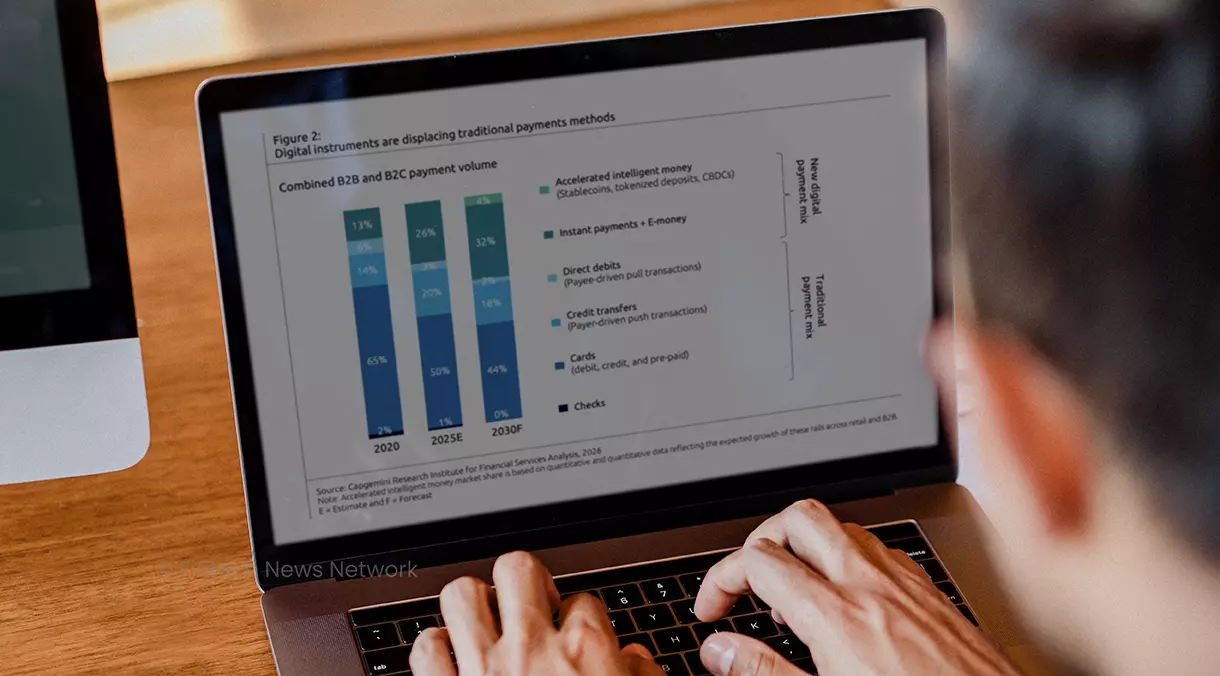
In 2025, new digital payment methods accounted for 26% of business-to-business (B2B) and business-to-consumer (B2C) payment volume. The figure marks a 13-point increase from 2020.
These payment methods are capturing B2B and B2C market share from traditional methods. In 2020, traditional payment methods accounted for 87% of B2B and B2C payment volume, but by 2025, that share had fallen to 74%.
By 2030, traditional methods are projected to drop to 64%, with credit transfers and cards declining by 2 and 6 points, respectively, while checks may nearly disappear.
Meanwhile, new digital instruments are expected to climb 10 points to 36% by 2030. This growth will stem from instant payments and e-money rising 6 points, alongside intelligent money, including stablecoins, tokenized deposits, and central bank digital currencies (CBDCs), which is set to make up 4% of total B2B and B2C payment volume.
Accelerated intelligent money is progressing through technological advances and regulations that generate a cross-market ripple effect, boosting confidence in these instruments.
In Singapore, the central bank began directly regulating single-currency stablecoin issuers in August 2023. In parallel, the Monetary Authority of Singapore (MAS) is advancing wholesale CBDC development for interbank settlement and launched BLOOM in October 2025 to support interoperable, multi-currency digital asset settlement across domestic and cross-border markets.
Source link