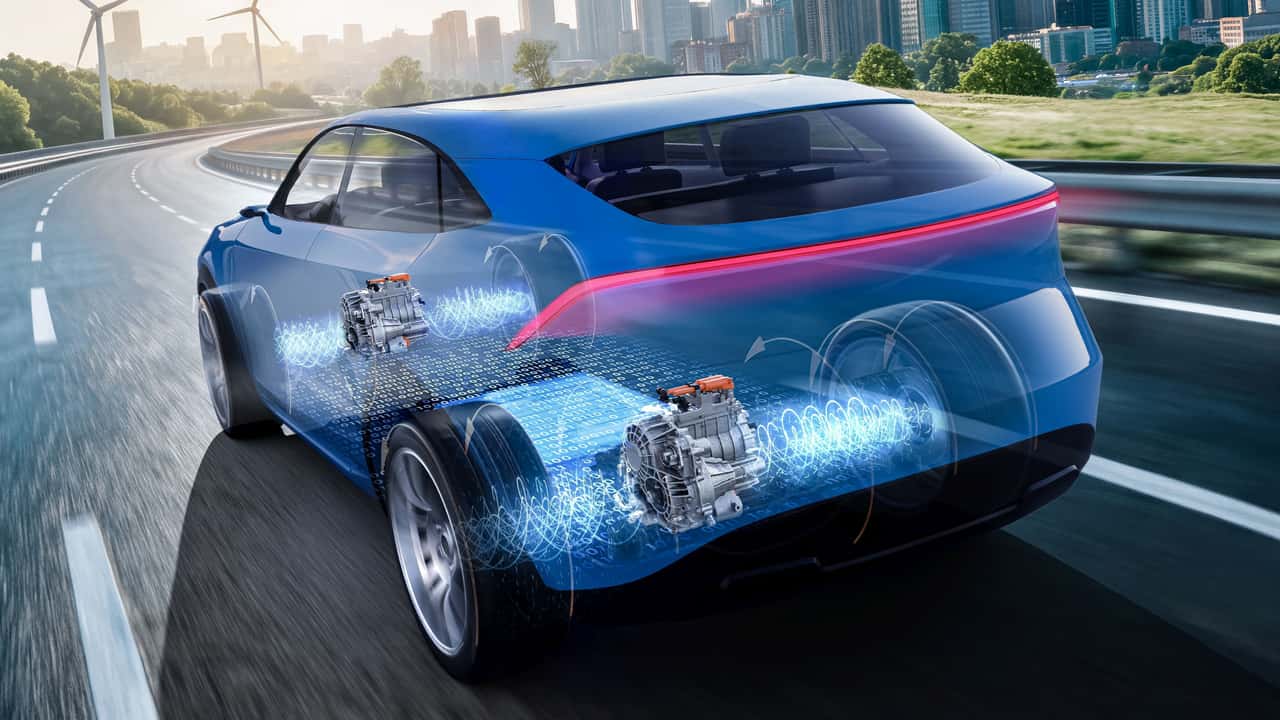
An electric motor spinning at 30,000 rpm sounds like something you might find in a high-power EV supercar. ZF has something less extravagant in mind: making the hardware that powers everyday EVs smaller, lighter, and less hungry for expensive materials.
ZF’s new High Revolution Drive combines the motor, power electronics, and transmission all in the same housing. Unlike Mercedes-Benz, though, it doesn't also put the brakes inside the same housing.
Compared with one of ZF’s comparable Select drive units, which spins up to 18,000 rpm, the company claims nearly 25% less weight and volume, half the magnet mass, and a similar efficiency of almost 93%.
This helps because less mass improves EV range, and fewer magnets reduce costs and supply-chain dependence.
According to ZF, spinning the motor faster lets it deliver the same power from a smaller, lighter package. Gears then reduce that speed and increase the turning force sent to the wheels, using a reduction ratio of about 18:1. The version ZF showed produces up to 268 horsepower, with the gearing delivering peak torque of 2,581 pound-feet (3,500 Nm) to the wheels.
The torque measurement comes after the gearing has multiplied the motor’s output. The “two-stage transmission” doesn’t actually mean a two-speed gearbox. It describes successive gear reductions, not two separate driving ratios.
The company says the production High Revolution Drive should deliver 200 to 268 hp and work with both 400- and 800-volt platforms. Reusing its modular Select architecture should simplify installation, shorten development and control costs, and retain manufacturing flexibility.
Source link