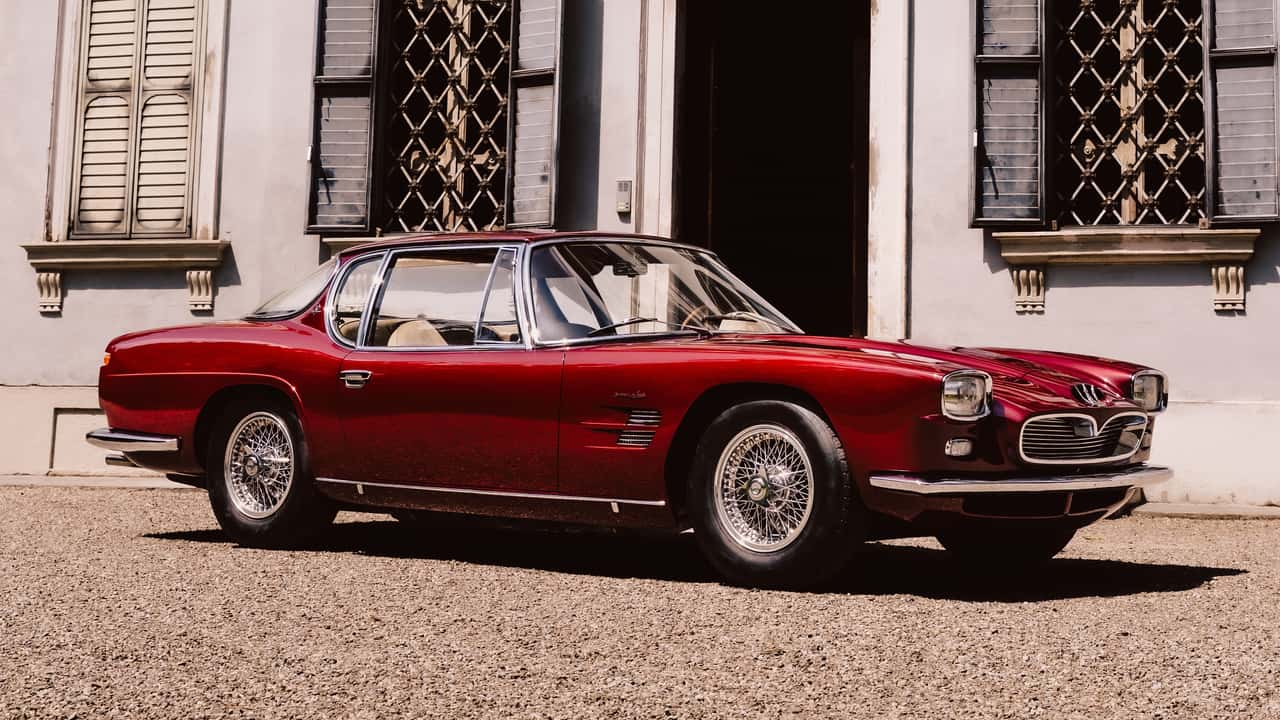
Maserati has handed its Classiche certification to a car that spent three decades locked in an Egyptian warehouse. Chassis 103*064* is the first 5000 GT ever bodied by Pietro Frua. It is now the first 5000 GT Frua to carry the authentication.
Only 34 examples of the 5000 GT were built, and Maserati marks their production span from 1959 into the mid-1960s. Three of those cars wore Frua's bodywork.
This one's history runs through a shah, an imam, and a Saudi king before it vanished entirely.
The 5000 GT exists because the Shah of Persia drove a Maserati 3500 GT and wanted something grander. Technical director Giulio Alfieri answered with project AM103. He dropped a 5.0-liter V8 derived from the Maserati 450S race car into a road-going grand tourer rated at over 350 hp.
Carrozzeria Touring built the first three cars. They appeared at the 1959 Turin Auto Show and picked up the "Shah of Persia" nickname after the man who started it all. Maserati then opened the AM103 platform to other coachbuilders, and Allemano, Pininfarina, Monterosa, Ghia, and finally Frua each put their own body on the same mechanical foundation.
Pietro Frua built three 5000 GTs in 1962, and chassis 103*064* was the first. It wore a "Luci di Mezzanotte" exterior over "Camoscio" interior trim, with a lower beltline and larger glass area that gave it a sleeker profile than the Touring and Allemano cars before it.
Maserati used the car for testing trials before putting it in front of the public at the 1963 Geneva Motor Show.
Source link