
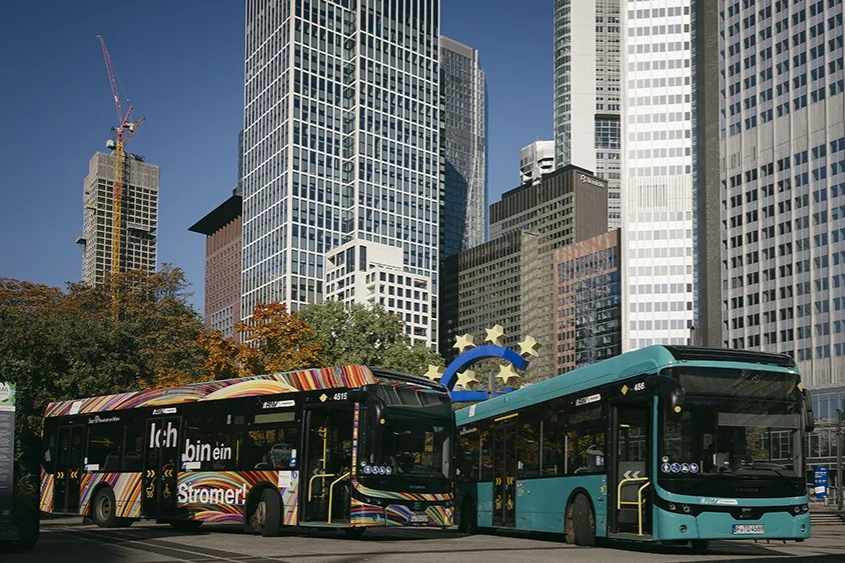
In Frankfurt am Main, more than 100 buses are now either battery-electric or using fuel cells. Most recently, operator Transdev Rhein-Main (TDRM) has added nine electric buses from the struggling Dutch manufacturer Ebusco to its fleet.
TDRM is deploying these new electric buses on line 56 between Rödelheim, Sossenheim and Eschborn, as well as on line 71 in Praunheim and the Nordweststadt district.
In Frankfurt’s bus network, 109 out of a total of 418 buses now operate with locally emission-free drivetrains, accounting for well over a quarter of the fleet. According to the city administration, this makes Frankfurt’s e-bus fleet one of the largest in Germany. “With more than 100 e-buses, the transport transition in Frankfurt is visible to passengers and has become part of everyday life. The 100th electric bus symbolises the targeted transformation in Frankfurt’s bus services and the successful path the city has pursued since 2018,” said Transport Councillor Yannick Schwander.
A unique feature of Frankfurt’s battery-electric buses is that they are charged with electricity generated at the Heddernheim waste-to-energy plant (MHKW). The MHKW is operated by Frankfurter Entsorgungs- und Service GmbH (FES) and energy supplier Mainova. Among other things, it generates electricity by incinerating household waste. “This unique collaboration in Germany links waste incineration, energy generation and locally emission-free mobility,” explains TDRM Managing Director Wolf. “Frankfurt demonstrates here how a city’s resources can be used efficiently while combining climate protection and public welfare,” added FES Managing Director Dirk Remmert.
However, in such a scenario, the emphasis is on “locally emission-free mobility”, as emissions are indeed produced during electricity generation at a waste incineration plant – just not at the vehicle itself.
Source link