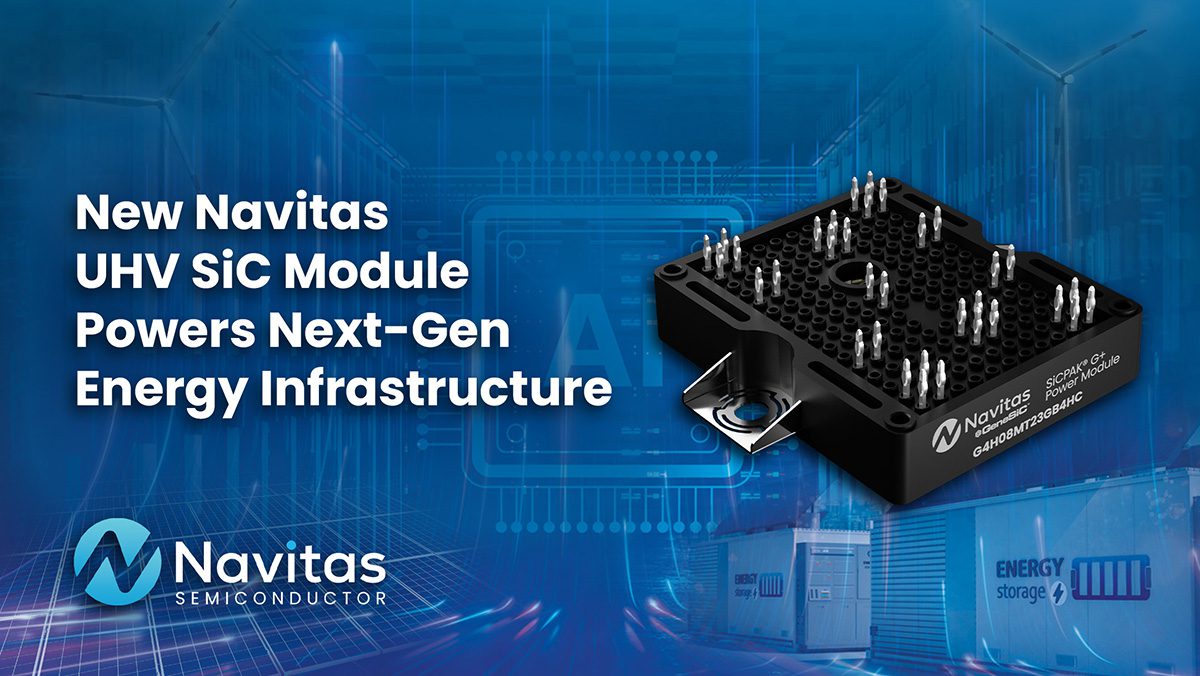
Navitas Semiconductor has introduced a family of 2,300 V full-bridge silicon carbide (SiC) power modules designed to improve efficiency and power density in solid-state transformers, grid-scale battery storage, solar inverters and EV megawatt charging infrastructure.
The G4H08MT23GB4 family uses the SiCPAK form factor and has an on-resistance of 8 mΩ. The modules are based on Navitas's fourth-generation GeneSiC Trench-Assisted Planar architecture and extend the company's 2,300 V and 3,300 V ultra-high-voltage SiC portfolio.
An aluminum nitride active-metal-braze substrate provides heat spreading and supports isolation of more than 5 kV. The epoxy-resin potting is designed to reduce internal stress and limit moisture and contaminant ingress. Navitas says the potting has 10 times the thermal conductivity of silicone gel.
Navitas says the optional high-current press-fit pins have twice the current-carrying capability per pin of standard press-fit connections. An optional pre-applied thermal interface material (TIM) is designed to simplify and standardize heatsink assembly.
The family will be qualified to AEC-Plus, an internal reliability benchmark that Navitas says goes beyond AEC-Q101 and JEDEC requirements. AEC-Plus includes dynamic reverse bias and dynamic gate switching tests to represent fast-switching mission profiles. AEC-Plus also more than triples the duration of static high-temperature, high-voltage tests and adds extended power-cycling and temperature-cycling testing.
Samples are available in four versions, with or without the pre-applied TIM and with standard or high-current pins. A double-pulse test system, the EVB-UHVSIC-GB-E-DPT-1, is available on request to help engineers evaluate switching performance.
"Our fourth-generation GeneSiC Trench-Assisted Planar architecture continues to push the limits of what's possible in ultra-high voltage SiC," said Paul Wheeler, Vice President and General Manager of Navitas's SiC Business Unit.
Source link