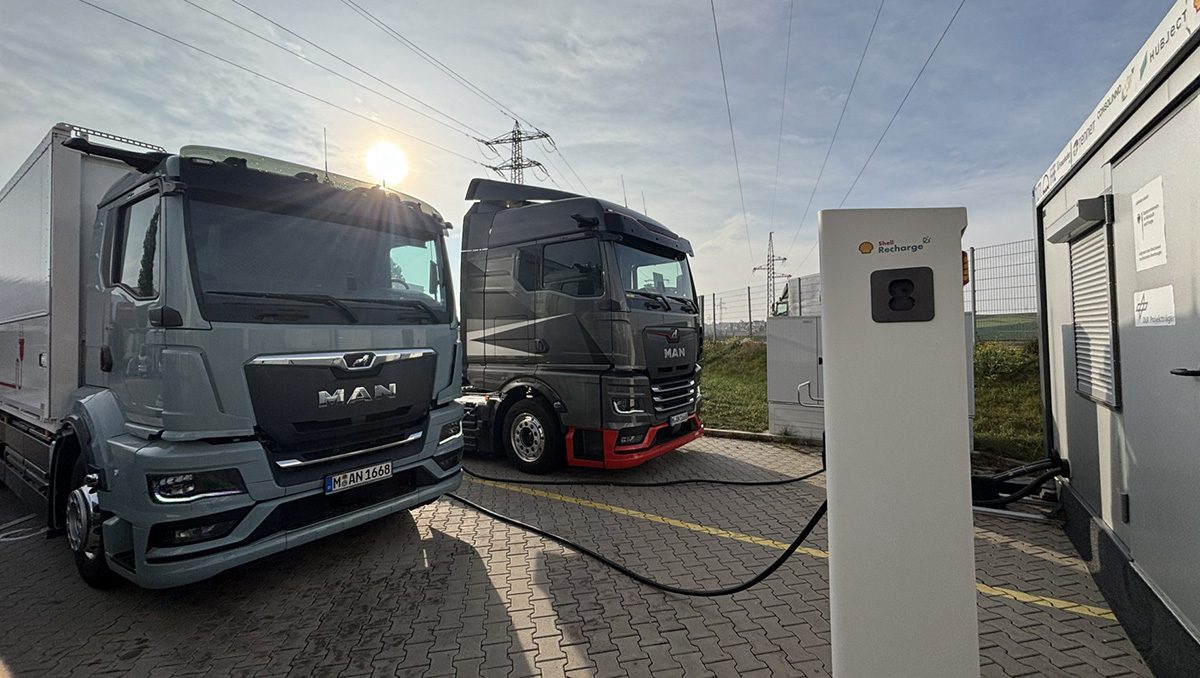
The SPIRIT-E research project, which includes MAN Truck & Bus and Traton R&D, has shown that electric trucks can store energy and feed it back into local and public power grids.
Led by the Technical University of Munich (TUM), the project tested bidirectional charging at freight forwarder Spedition Schmid’s depot in Regensburg, Germany, from August 2023 to October 2026.
Bidirectional charging functions were developed and tested on the MAN eTGX electric truck and on mobile and stationary charging systems from project partner SBRS. The partners coordinated the interfaces between the vehicle, charging station, charging operator control software, site energy management system, electricity trader and grid operator.
The project implemented ISO 15118-20, the standard for communication between vehicles and charging infrastructure during charging and discharging. An eTGX with 480 kWh of usable energy fed electricity through a bidirectional DC charging station at up to 350 kW into the depot’s energy network (vehicle-to-site, or V2S) and the public grid (V2G). The truck also charged other vehicles from its battery (V2V).
In a test environment from software company PowerBot, the partners simulated an electric truck buying electricity when prices are low and selling it when they are high. Using the Equigy platform, the project also demonstrated how electric trucks can help grid operators ease bottlenecks in the electricity network.
Whether bidirectional charging pays off depends on factors including operating profiles, annual mileage, dwell times, battery size, electricity prices, grid charges, on-site power generation and grid connection capacity. The partners say bidirectional charging is particularly attractive for trucks with regular depot dwell times and annual mileage below 100,000 km.
Source link