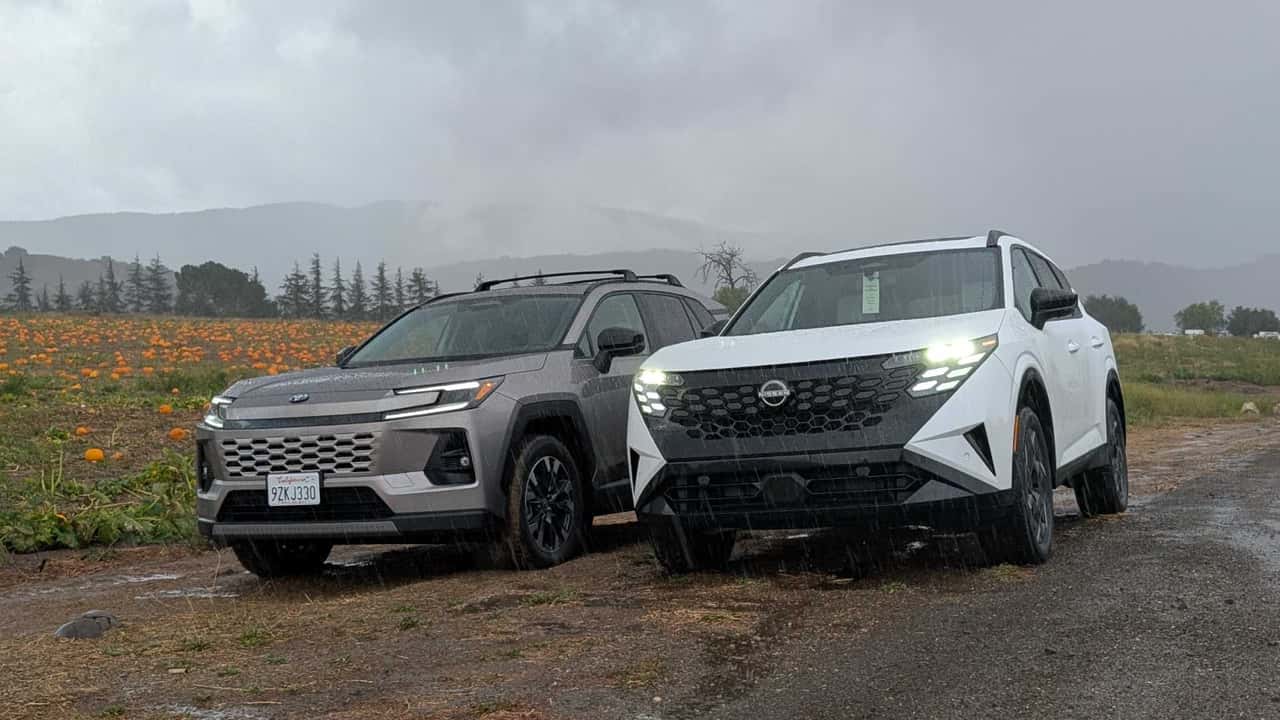
As drivers get squeezed at the pump due to high gas prices, they’re increasingly seeking cars that can go farther on a tank of gas, leading to record sales of hybrids for Toyota, Honda, Hyundai, and Kia this year.
Nissan, however, has been notably absent from this party, with no plug-less hybrid in its U.S. lineup. The 2027 Rogue Hybrid finally changes that, and it will lock horns with rivals such as the Toyota RAV4, Honda CR-V Hybrid, and Hyundai Tucson Hybrid. But does it have what it takes to challenge these more established names in this segment?
I drove the new Rogue last week and came away impressed. Its unique powertrain makes the gas engine work solely as a generator to charge the battery. The engine has no mechanical connection to the wheels, which are driven by electric motors the whole time.
As a result, the Rogue drives like an EV with impeccable refinement and smoothness. I drove it back to back with the RAV4, and the Rogue felt superior with its EV-like traits. The RAV4 outperforms in some other areas, but the Rogue is particularly strong when it comes to driving characteristics. Let’s dive right in.
[Full Disclosure: Nissan invited me to drive the 2027 Rogue Hybrid in Santa Barbara, California. It paid for travel, accommodation, and food.]
Don’t let anyone fool you into thinking that hybrids are new. They’re older than the iPhone. S. debut in 2000, and while hybrid technology has incrementally improved since with efficiency and performance gains, the basic formula is unchanged: pair a gas engine with one or more electric motors and a small battery for better fuel economy.
Source link