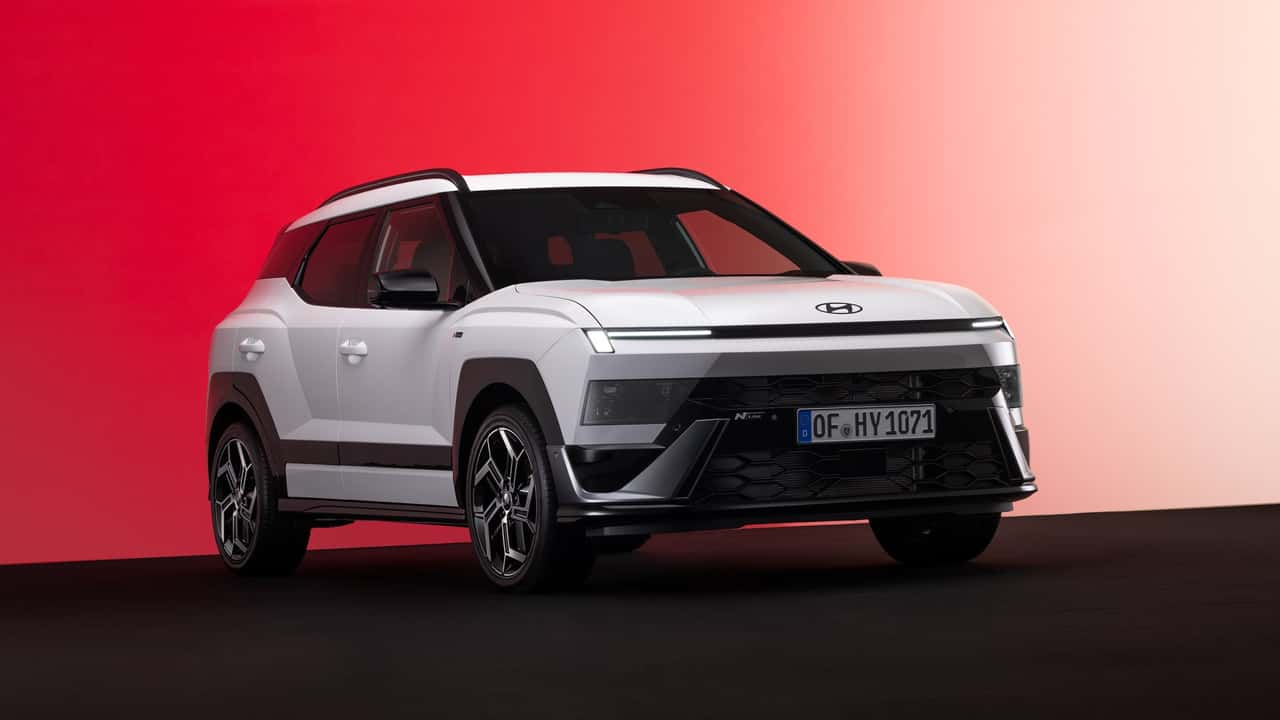
Like everywhere else, Europeans have an insatiable thirst for crossovers. That's why Hyundai feels confident giving the Bayon a second generation, even though the Kona was once the brand’s entry-level SUV. The new model is growing in almost every direction and gaining a more angular design.
Looking as if a Kona and a next-gen Elantra spent the night together, the new Bayon features sharper creases, pronounced fenders, chunky body cladding, and a more upright stance. A full-width horizontal lighting signature dominates the front end, while projection LED headlights with static bending lights provide additional illumination. The rear echoes the front lighting treatment, and an angular skid plate reinforces the crossover’s rugged appearance.
Hyundai is keeping the Bayon compact enough for urban driving, but the new model is noticeably larger than its predecessor. At 4,245 millimeters (167.1 inches) long and 1,810 mm (71.3 in) wide, it gains 65 mm (2.6 in) in length and 35 mm (1.4 in) in width. The wheelbase measures 2,600 mm (102.4 in), while ground clearance varies by powertrain and wheel size.
Buyers can choose alloy wheels up to 18 inches, a two-tone roof, and solid, metallic, pearl, or matte exterior finishes. Available from day one, the sportier N Line stands out with dedicated 18-inch wheels, technical mesh details, high-gloss black cladding, and a rear diffuser incorporating twin exhaust outlets. Inside, the range-topping trim gets cloth and suede seats with red accents.
Practicality remains a priority. 5 cubic feet) of luggage capacity, with additional storage beneath the cargo floor.
Source link