Now a focal point of automotive fleets, the next stage of EV evolution is centered around reducing the space and weight of architectures to unlock further driving range as well as improving thermal management to enable faster charging.
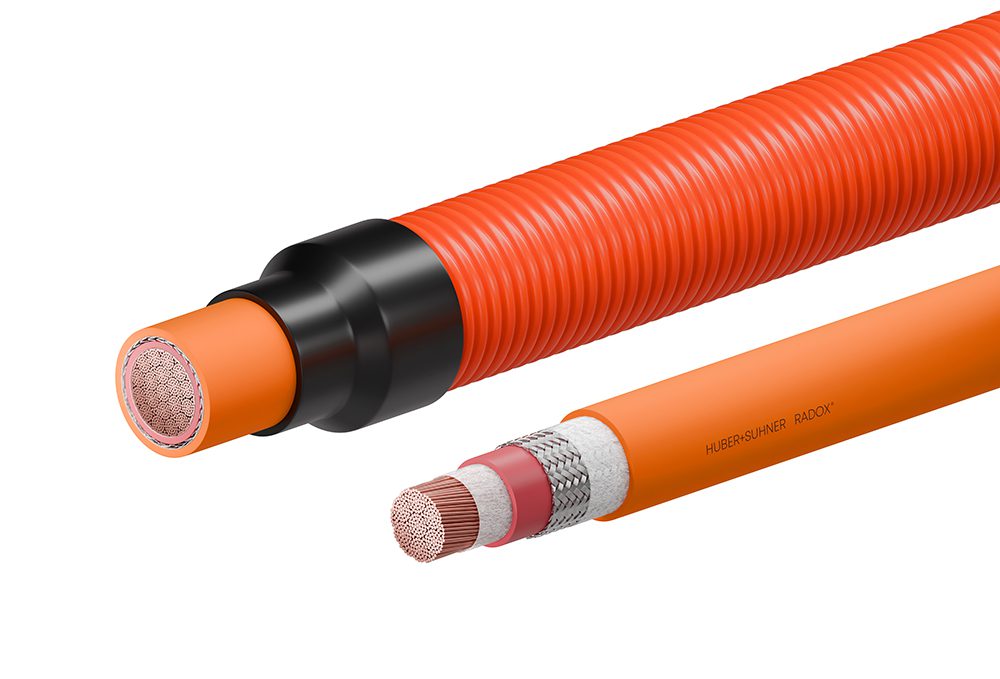
One area attracting renewed interest to facilitate this is rethinking the components that surround the vehicle powertrain. This includes the high voltage (HV) cables that act as the main arteries of an EV, transmitting high power electricity from the traction battery to core drivetrain and auxiliary components.
Traditional cable setups have been oversized by design to safely contain the jump to 800V and added severe Electromagnetic Interference (EMI), contributing to a heavier vehicle architecture. With Original Equipment Manufacturers (OEMs) demanding lighter vehicles, the first step must come in the form of downsizing these cables and improving thermal management without compromising performance.
One proven approach to this problem is the pioneering RADOX® technology from HUBER+SUHNER. A specialized leader in specific high-performance niches of the automotive and transportation sector, RADOX® technology was initially built over four decades ago using expert Swiss engineering.
RADOX® stands for radiation crosslinking, referring to the process of crosslinking thermoplastic polymers using electron beams. The cables never melt, possess better abrasion and cut resistance, greater flexibility, and even with thinner insulation, are more resistant to harsh environments, making them a natural fit for the abundance of exposures present in EVs.
While RADOX ® has already been demonstrated its capabilities across demanding applications in rail, offshore energy, and fiber optics, its performance in the automotive and EV sector presents another compelling use case for the technology – particularly as corrugated tubed HV cables prove surplus to requirements across many vehicle applications.
Source link