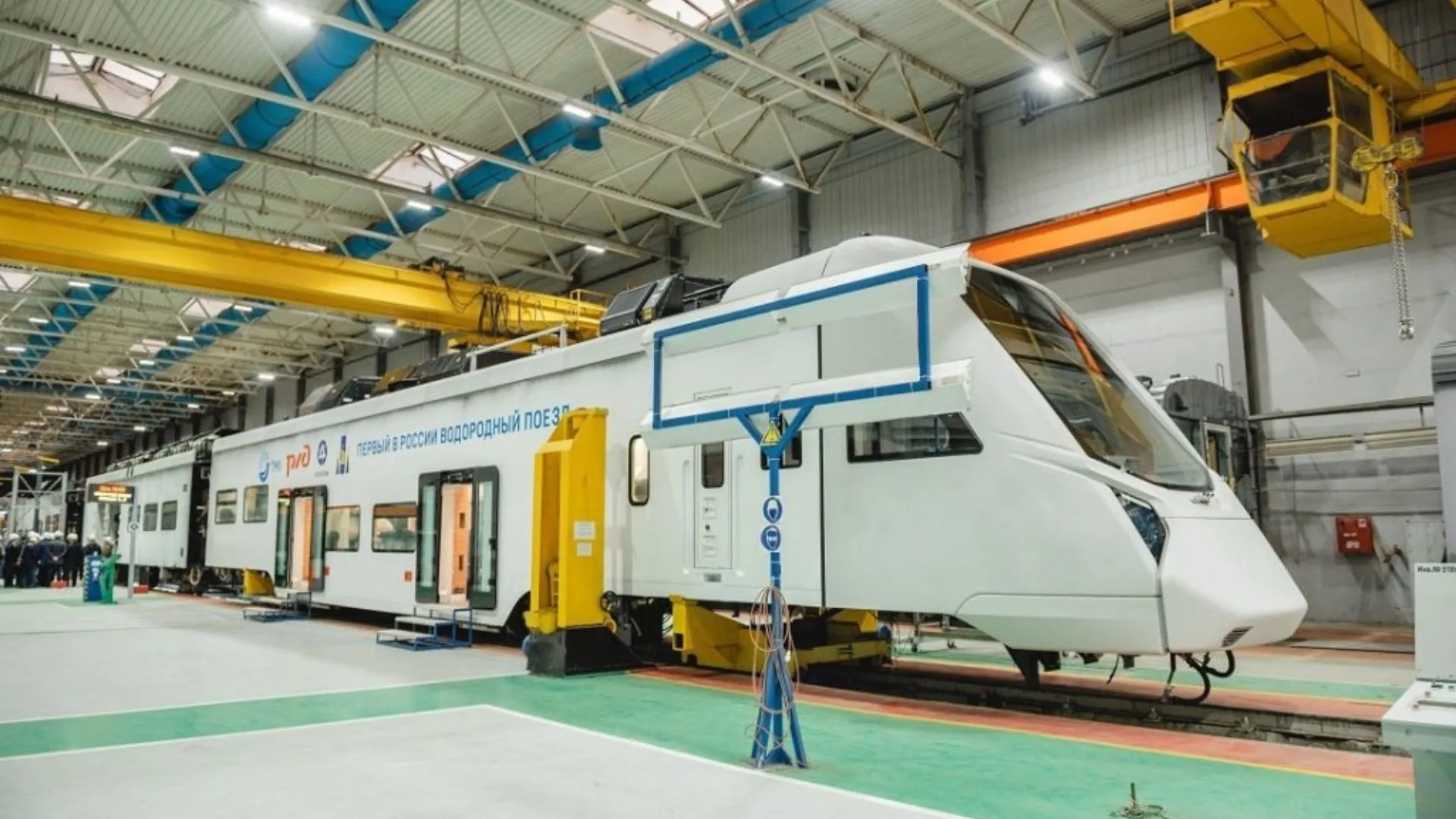
Russia is shifting to cleaner alternatives for its rail system that currently relies on polluting diesel engines.
On Wednesday, October 28, Moscow announced that its first home-built hydrogen-powered passenger train, capable of traveling more than 435 miles (700 km) on hydrogen alone and up to 460 miles (740 km) with onboard battery support, was successfully assembled at a factory in Demikhovo.
The first set of these trains will operate on Sakhalin, a Russian island in the Pacific Ocean, north of Japan.
The assembled trains, designed for non-electrified railway lines, are the first low-floor passenger railcar model built in Russia to run be hydrogen fuel cells.
In the long run, they are expected to provide a cleaner alternative to diesel-powered locomotives that emit a toxic mix of pollutants during combustion. The hydrogen power system will emit water vapor rather than the exhaust fumes produced by diesel engines.
The inter-city hydrogen trains are being designed and built by Transmashholding (TMH), one of Russia’s largest manufacturers of railway rolling stock and urban transit equipment.
The company is working alongside Russian Railways, Rosatom and the Sakhalin regional government to develop hydrogen-powered trains under an agreement signed in 2019.
Work on Russia’s first hydrogen-powered train “has been underway for several years, and the assembly phase is due to be completed this year. In practice, the train has already been assembled and is moving into the testing phase,” said Valeri Limarenko, Governor of the Sakhalin Region.
Testing of the first hydrogen train, built with the new low-floor design, is scheduled to begin in November this year.
Source link