
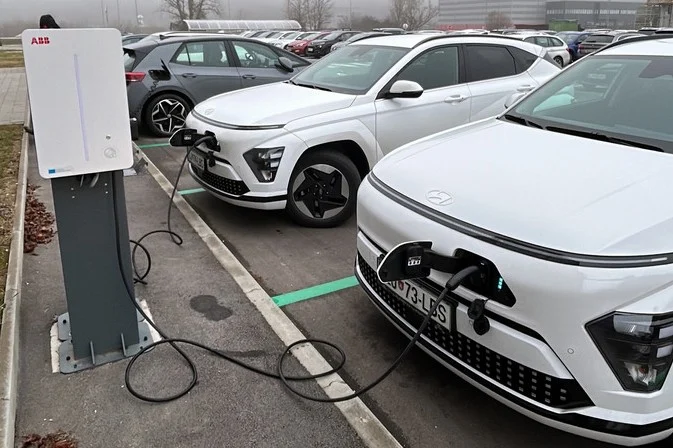
The EU bidirectional charging project EV4EU has concluded its work after four years. The partners developed a bidirectional CCS charging prototype and open-source software for charging point operators, among other things. Four demonstration projects show how electric cars can contribute to the adaptability of the power system.
The European research project EV4EU has concluded after four years of operation. Its goal was to develop and test solutions enabling electric vehicles not only to consume electricity but also to serve as flexible resources within the energy system – namely, bidirectional charging. Key outcomes include a fully functional prototype of a bidirectional charging station based on the Combined Charging System (CCS) and freely available open-source software for charging point operators. Funded by the EU with approximately nine million euros, the project was coordinated by the Portuguese research institute INESC-ID. A total of 16 project partners and six associated partners were involved.
At the heart of the project was the Vehicle-to-Everything (V2X) concept. This umbrella term encompasses various ways to feed energy back from the vehicle battery or exchange it with other systems, such as Vehicle-to-Grid (V2G). In this case, the electric vehicle supplies power back to the public grid, which can help mitigate peak loads or utilise excess renewable energy at a later time.
Vehicle-to-Home (V2H) refers to supplying a house with energy from the vehicle battery, for example when a rooftop photovoltaic system is generating little power. Vehicle-to-Building (V2B) addresses commercial or public buildings. Vehicle-to-Load (V2L), on the other hand, enables electrical devices to be powered directly from the vehicle—such as tools or camping equipment.
Source link