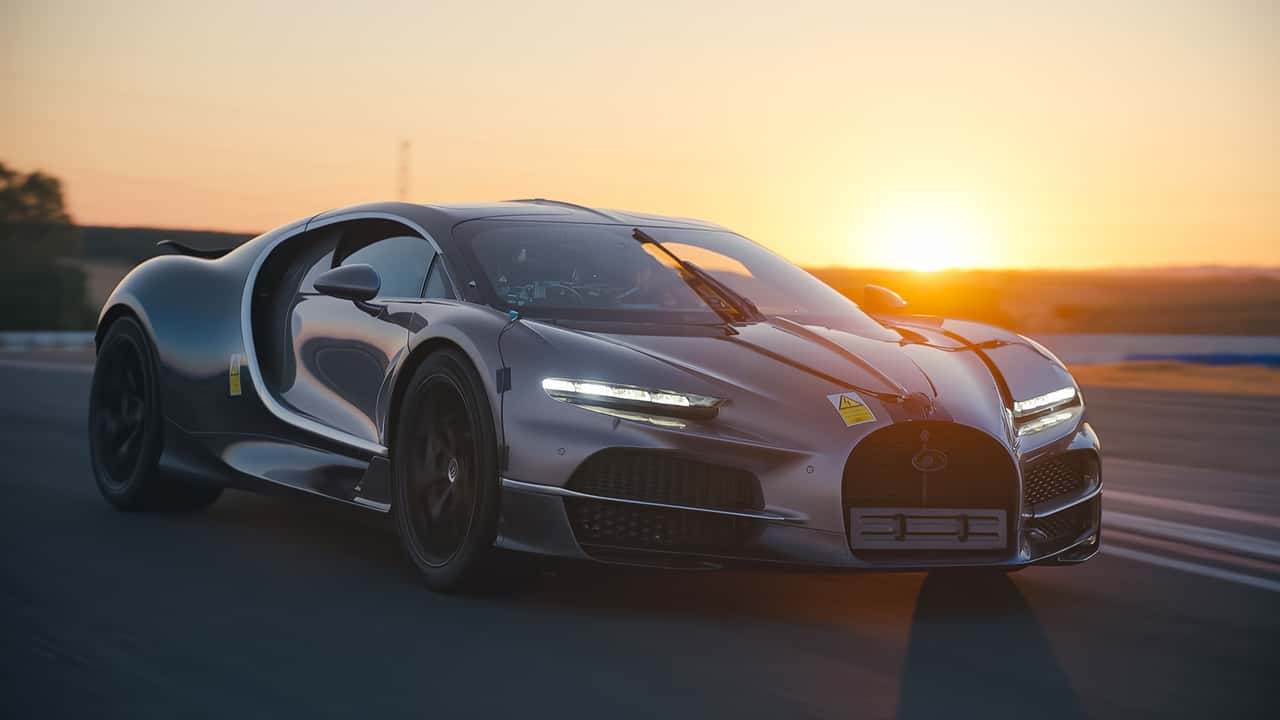
Bugatti has a new episode in its "A New Era" documentary series, and this one is about heat, not snow. The development team took the Tourbillon to Seville, where track and road temperatures climbed past 45°C (113°F), to see whether the hypercar's cooling systems could keep both the powertrain and the cabin under control.
The Tourbillon pairs a naturally aspirated V16 with three electric motors for a combined 1,800 horsepower. Two of the motors sit on the front axle, with a third backing up the V16 at the rear, and an 800V battery ties it all together. That architecture generates a thermal load Bugatti needed to prove it could manage without reshaping the car's bodywork.
The Spanish test program followed earlier validation runs in Dubai and Sweden. Together they round out a climate trial meant to expose weaknesses before customer cars reach the road. More than 200 thermocouples were wired through the prototype to track how individual zones responded as the car moved between environments.
Daniel Ríos Hidalgo, a vehicle development engineer at Bugatti Rimac, said the goal was cooling the cabin and engine bay without compromising the car's shape. "In order not to compromise the shape and the design, we have very clever cooling circuits and cooling systems inside the car to make sure that all the systems remain under controlled temperatures," he said.
Paolo Magrone, a vehicle development driver at Bugatti Rimac, said performance came ahead of comfort for its own sake. " The Tourbillon's interior was engineered with that same priority in mind, long before the Seville heat tested it.
Source link